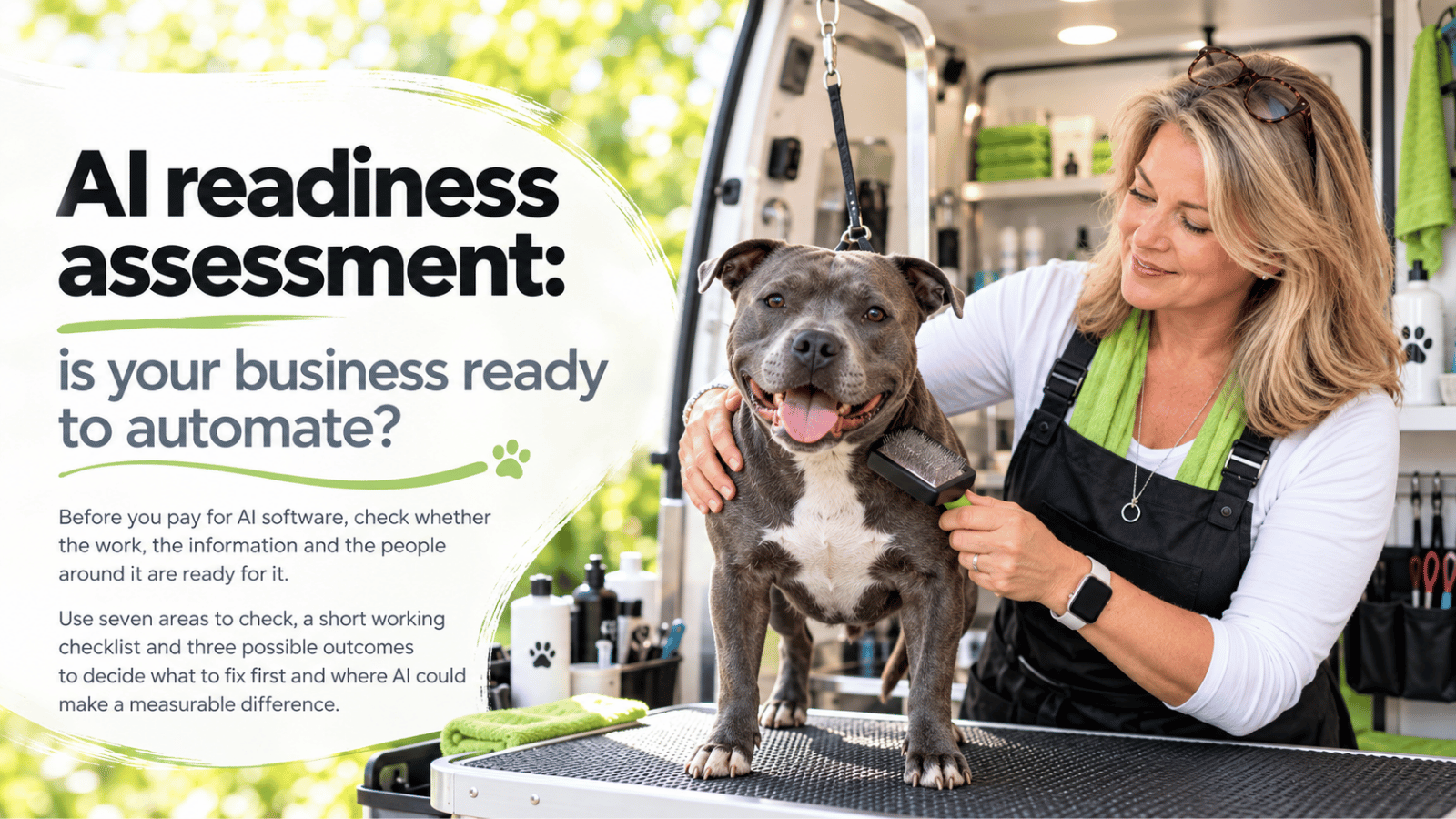
An AI readiness assessment checks whether your business has a measurable problem, a consistent process, reliable information, connected systems, a named owner, safe controls and realistic costs for using AI. The result tells you whether to test a small pilot now, prepare the groundwork first or use a simpler approach. It does not prove legal compliance, and a score on its own is not a certificate.
The hardest part of using AI in a business is often finding the right job for it. In the UK government’s AI Adoption Research, updated in February 2026, the barrier businesses reported most often was that they had not identified a use for AI in their organisation (71%). Limited AI skills, expertise or knowledge came next (60%).
The same survey found that around 1 in 6 businesses (16%) were using at least one AI technology. Among businesses planning to adopt AI, 34% said they felt ready to implement it. Readiness can be checked before you spend anything, and the seven-part framework below shows you how.
Key points to act on before you spend on AI
- Start with a problem you can measure, such as response time or rework, then decide whether AI is the right fix.
- Automating an inconsistent process copies the inconsistency. Map and simplify the process first.
- Check seven areas: goals, processes, data, systems, people, risk and governance and commercial feasibility.
- A serious data protection or accountability gap should pause a project, however well the other areas score.
- Some assessments end with “use something simpler”. That is a useful result.
Which AI readiness assessment you need, so you pay for the right review
An AI readiness assessment is a structured review of whether an organisation has the processes, information, systems, people and controls needed to use AI safely and effectively. It looks at how the work runs today, not at which software to buy.
The term covers several kinds of review. They answer different questions, so it helps to know which one you need before asking anyone for one.
| Type | What it covers | What you receive | When it fits |
|---|---|---|---|
| Preliminary readiness assessmentOften free, self-completed | Short questions across the main readiness areas | An indicative result and a list of likely gaps | You are exploring and want to know where to look first |
| Detailed AI readiness auditPaid, specialist-led | Your real processes, data, systems, people and controls | Written findings, risks, prioritised recommendations and next steps | You want evidence before committing money to AI work |
| AI strategy and implementation planFollows an audit | Which opportunities to pursue, in what order, with owners and costs | A sequenced plan with measures of success | The audit has confirmed opportunities worth pursuing |
| AI maturity assessmentOrganisation-wide | How far AI use has developed, usually against staged levels | A maturity level by area | You already use AI and want to extend or govern it |
| Technical feasibility reviewOne workflow | Whether one process can be automated with the tools, data and access you have | A clear answer with conditions and a build outline | One workflow is chosen and you need to know it will work |
Assess before you buy AI tools, so your money fixes a real problem
A tool bought before the problem is defined tends to sit on top of the existing process. If the process is inconsistent, the tool makes the inconsistency faster. The government research gives a sense of where businesses get stuck.
What stops UK businesses adopting AI
Share of surveyed businesses citing each factor as preventing, or having previously prevented, AI adoption. Businesses could give more than one answer, so the figures do not add up to 100%.
The two most common barriers are about the business, not the technology: no clear use and limited know-how. Both can be worked on before buying anything. The same research also noted that when businesses rated how significant each barrier was, ethical concerns, high costs and unclear regulation were seen as the most serious.
This is an illustrative planning example, not a real client or result.
A small professional services firm receives new enquiries through a website form, two email inboxes and the phone. Details are copied into a spreadsheet when someone remembers. Whoever sees an enquiry first replies, so some get two answers and some get none. Nobody knows the current response time.
Approach A: buy a chatbot first and speed up a messy process
Connect an AI chatbot to the existing setup.
- Choose a chatbot and add it to the website
- Enquiries still arrive through three other routes
- The chatbot answers from whatever information it was given
- Follow-up still depends on whoever notices
Approach B: fix the process first, then automate what pays
Fix the process, then add the right automation.
- Map every route an enquiry takes and who touches it
- Bring enquiries into one inbox and one record
- Name an owner and a response target
- Record the current response time as a baseline
- Automate routing and acknowledgement; let AI draft replies for a person to approve
Approach B does not promise a saving. It gives you a consistent process, a named owner and a starting figure, which is what makes any improvement measurable. It may also show that the routing and acknowledgement steps need no AI at all.
Check seven areas of your business, so you automate without wasted spend
Each dimension below asks one core question. Work through them for a specific process, not for the business as a whole. A business can be ready to automate its reporting and not ready to automate its customer replies.
- Dimension 1Business goalsCan you name a problem and measure it?
- Dimension 2ProcessesIs the work documented, consistent and repeatable?
- Dimension 3DataIs the information complete, reliable and suitable?
- Dimension 4SystemsCan your tools exchange information reliably?
- Dimension 5PeopleWho owns it, and can they operate and check it?
- Dimension 6Risk and governanceAre personal data, accuracy and oversight under control?
- Dimension 7Commercial feasibilityDo the costs, benefits and simpler options stack up?
- The override ruleA serious data or safety gap pauses the project firstA serious gap in dimension 6 pauses the project, however well the other six score.
1. Business goals: name one problem you can measure, so you can prove a result
AI is worth paying for when it changes something you can measure. Without a starting figure, you cannot tell whether a pilot worked or simply felt busy.
Three questions to answer- Which problem costs the business the most time, money or customers right now?
- How do you measure it today, for example response time, processing time, error rate, rework or operating cost?
- What result would make a change worth its cost?
Signs this area is ready to automate
- One named problem with an agreed owner
- A current figure, even a rough one
- Agreement on what “better” would look like
Signs to fix this first
- The goal is “use AI” or “keep up with competitors”
- Several goals competing for the same budget
- No current figure for the problem
One practical improvement: Record the current figure for one problem for two weeks before speaking to any supplier.
2. Processes: make the work run the same way, so automation does not copy mistakes
Automation follows the process it is given. If each person handles the task differently, the automation copies one version and the exceptions pile up elsewhere.
Three questions to answer- Is the process written down, step by step?
- Do two people handling the same task do it the same way?
- Can you point to where decisions, exceptions and handovers happen?
Signs this area is ready to automate
- Written steps that people actually follow
- A clear trigger and a clear finish
- Known exceptions with an agreed route
Signs to fix this first
- The process lives in one person’s head
- Steps differ depending on who is working
- Handovers rely on memory or chat messages
One practical improvement: Write the process as it runs today on one page, including the exceptions and who hands over to whom.
3. Data: trust your information first, so AI does not act on bad records
AI output is only as reliable as the information it reads. Missing, duplicated or out-of-date records produce confident answers that are wrong.
Three questions to answer- Is the information the process needs complete and up to date?
- Where is it stored, and can the right people reach it?
- Is it suitable for this use, including any personal or confidential information?
Signs this area is ready to automate
- One main source for each type of record
- Fields filled in the same way by everyone
- A named person who keeps it accurate
Signs to fix this first
- The same customer appears in several spreadsheets
- Key details exist only in free-text notes
- Uncertainty about what personal data is held
One practical improvement: List every place the process’s information lives and choose one to be the source everyone updates.
4. Systems: connect your tools, so nobody copies details by hand
Much of the value in automation comes from tools passing information reliably without someone copying it across. Integration limits often decide what is practical.
Three questions to answer- Which applications does the process touch, from first contact to finish?
- Can they connect, through a built-in link or an automation platform?
- What permissions, plan limits or access problems would stop them?
Signs this area is ready to automate
- Tools that already offer integrations
- Known admin access for each account
- Current subscription plans that allow connections
Signs to fix this first
- Details copied by hand between tools
- Nobody holds the admin login
- An older tool with no way to connect
One practical improvement: Sketch the tools the process uses and mark each handover between them as automatic or manual.
5. People: name an owner, so results get checked before customers see them
Someone has to own the process, notice when an output is wrong and handle what the system cannot. The government research found that 84% of businesses using AI applied at least some human input or checking to its outputs.
Three questions to answer- Who owns this process and its results?
- Do the people involved understand what would change and why?
- Can they operate the new system and check what it produces?
Signs this area is ready to automate
- A named owner with time set aside
- The people doing the work are involved early
- Someone who can spot a wrong output
Signs to fix this first
- The owner is “everyone”
- Changes decided without the people who do the work
- No time allowed for checking
One practical improvement: Name one owner for the process and agree how many hours a week they can give a pilot.
6. Risk and governance: keep personal data and accuracy under control, so a pilot cannot harm customers
Using AI with personal data brings UK GDPR duties. The Information Commissioner’s Office publishes guidance on AI and data protection and an AI and data protection risk toolkit for assessing the risks an AI system creates for individuals. Check the current versions before relying on them.
A readiness check can show which questions need answering. It cannot confirm that a process is lawful. A preliminary score never proves compliance.
Three questions to answer- Will the process use personal or confidential information, and do you know your lawful basis for using it this way?
- Who can access the tool and what it produces?
- What happens when an output is wrong, and who reviews it before it reaches a customer?
Signs this area is ready to automate
- The types of data involved are listed
- Access limited by role
- A review point and an escalation route are defined
Signs to fix this first
- Customer details pasted into free tools
- Outputs reach customers without a check
- Nobody has checked whether a data protection impact assessment is needed
One practical improvement: Before any pilot, list the personal data involved and work through the ICO guidance, or take specialist advice.
7. Commercial feasibility: check the numbers, so you only pay for AI where a simpler fix will not do
The subscription is rarely the whole cost. Set-up, connection, checking time and upkeep all count, and a simpler non-AI fix can sometimes solve most of the problem for less.
Three questions to answer- What will it cost to set up, and what will it cost each month after that?
- What benefit do you expect, and how will you measure it?
- Would a simpler option, such as a rule-based automation or a change to the process, solve most of the problem?
Signs this area is ready to automate
- Set-up and running costs estimated
- A success condition written down
- Simpler options considered and priced
Signs to fix this first
- Only the subscription price considered
- The benefit is “saves time” with no measure
- Nobody has checked a rule-based option
One practical improvement: Write a one-line success condition, such as “every enquiry acknowledged within one working hour for eight weeks”, and price the simplest option alongside the AI one.
AI readiness checklist: rate one process in seven clicks and see what to fix first
Choose one process you are thinking of automating, then rate it against each dimension. Your results sort themselves underneath as you click. This short checklist is a starting point. It does not replace a full assessment.
Rate one process against the seven dimensions
Ready nowYou could show evidence today, such as a written process or a current figure.
Needs attentionPartly in place. You can fix it yourself with some time.
Requires specialist reviewLegal, security or technical questions you cannot answer with confidence.
Ready now
Nothing rated yet
Needs attention
Nothing rated yet
Specialist review
Nothing rated yet
Rate all seven to see a suggested next step.
Pause before any pilot. You rated risk and governance as needing specialist review. Resolve the data protection, access and review questions first, whatever the other ratings show.
What your AI readiness score tells you, so you act on the gaps that matter
A readiness score is a way of organising priorities. It shows where the gaps sit and which ones to work on first. It is not an objective certification, and two assessments using different questions can score the same business differently.
Read any score alongside the risk involved, the context of the business and the feasibility of the specific workflow. An average hides detail. A business might score well overall because its goals, processes and systems are strong, and still be unprepared to automate one sensitive process. If that process involves replying to complaints that mention health details, the governance questions decide whether to proceed, not the total.
The PassivAi® AI Business Readiness Scorecard is being built on this principle. It will ask 21 questions across the seven dimensions, give a score out of 100 with a result for each dimension and show a separate warning when a serious governance or data protection issue appears, regardless of the total. It is not available yet. The preview below shows the planned results layout with made-up figures.
Result: prepare first
Goals and systems are in good shape. Process documentation and data need work before a pilot would give a reliable result.
Strengths
- A measured problem with a named owner
- Tools that already connect
Gaps to fix first
- Enquiry process not written down
- Customer records split across two spreadsheets
Recommended first action
- Map the enquiry process on one page and agree one record source
Suggested next step
- Re-check in four weeks, or request a scoped audit for a detailed review
Start with these processes, so your first pilot is low-risk and easy to measure
Good first candidates repeat often, follow clear steps and produce something a person can check.
The table shows what to measure for each one and the work that should stay with a person.

| Process | Why it is often a candidate | What to measure | Keep under human review |
|---|---|---|---|
| Customer enquiry handling | Frequent, time-sensitive and usually follows a pattern | Response time, missed enquiries | Quotes, complaints and anything unusual |
| CRM and data entry | Repeated copying between forms, email and records | Time per record, errors found | Merging or deleting records |
| Sales follow-up | Timed reminders that are easy to forget | Follow-ups sent on time, replies | Pricing, discounts and negotiation |
| Client onboarding | The same documents and steps for each new client | Days to onboard, chasers needed | Contracts, identity checks and exceptions |
| Document processing | Reading and extracting details from standard documents | Processing time, extraction errors | Anything with legal or financial effect |
| Internal reporting | Regular summaries built from the same sources | Hours to produce, corrections | Interpretation and decisions |
| Customer communications | Drafting routine updates and replies | Drafting time, edits needed | Final approval before anything is sent |
This article stops at choosing what to assess. For how a chosen process is mapped, built and checked, read business process automation using AI.
Your three possible results, and the next step that moves each one forward
A useful assessment ends with a decision, not just a score. The decision depends on the ratings and on the risk of the process.
Ready to test
The process looks prepared for a controlled, low-risk pilot.
Next stepChoose one pilot with a baseline figure, a named owner and written success criteria. Review it against the baseline before extending it.
Prepare first
There is a real opportunity, but the groundwork is missing.
Next stepFix the specific gaps: process documentation, unreliable data, access permissions or unclear responsibility. Then assess again.
Review the approach
AI may be unnecessary, premature or too complex for this job.
Next stepSimplify the process or use standard rule-based automation where generative AI adds complexity without adding value.
What a professional AI readiness audit should give you in writing, so you decide with the facts
A paid audit should go much deeper than a self-check. It looks at real examples of the work, the systems behind it and the risks involved, then turns that into decisions you can act on. Whoever provides it, the written output should cover these areas.
What gets checked in your business
- Review of current processes
- Repeated manual work and unnecessary handovers
- Data and software compatibility
- Suitable AI and conventional automation opportunities
- Privacy, security and operational risks
What you get to act on
- Commercial feasibility
- Prioritised recommendations
- A proposed implementation sequence
- Indicative costs and dependencies
- A recorded walkthrough of the findings
The audit and the implementation should be separate stages with a clear boundary. The audit tells you what to change. Building, connecting and supporting the changes is a different piece of work, scoped and priced on its own, and you decide whether to go ahead.
PassivAi® runs standard engagements remotely and in writing, without a sales call:
- Step 1Submit a briefDescribe the business and the process online
- Step 2Requirements reviewedYour brief is read and questions are sent in writing
- Step 3Written scopeYou receive the scope, package or proposal
- Step 4Agree and payPayment online once the scope is agreed
- Step 5Remote workThe assessment is carried out remotely
- Step 6Findings deliveredAn action plan and a recorded walkthrough
For larger engagements, generally above £2,000, a call can be arranged where the work justifies it. AI implementation shows how assessment, planning and implementation are staged and priced separately.
Your next step: find where AI would save your business time first
Start with the checklist above for the one process you most want to improve. If it shows mostly “ready now”, write the success condition and look at a small pilot. If it shows gaps you can fix, fix them and check again. If it shows questions you cannot answer, that is where a professional review earns its fee.
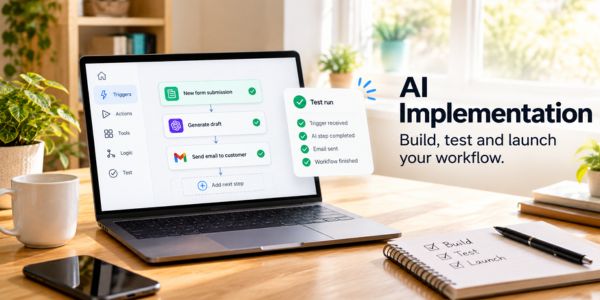
The free AI Business Readiness Scorecard will add a scored result for each dimension, the three most important findings and a suggested starting workflow. Until it is available, the AI implementation page has a quick three-question check of where AI could save your business time.
Three taps, your route shown straight away. No forms and no sales call.
 AI Transformation Audit
Get a written review of what to fix and automate first, without a sales call
Get a detailed review of your processes, systems and opportunities, with practical recommendations for what to improve and automate.
- Know what to change before you spend on software. Your processes, data and systems are reviewed against the seven dimensions in this article.
- See the risks while they are cheap to fix. Privacy, security and operational risks are set out alongside each recommendation.
- Decide on implementation with the costs in front of you. Recommendations come in order, with indicative costs, dependencies and a recorded walkthrough.
Opens the enquiry form. Describe your business and the process you want reviewed. You receive a written scope and fee before any work or payment is agreed.
An AI readiness assessment is worth doing before the first invoice, not after. Check the goal, the process, the information, the tools, the people, the risks and the numbers for one process. The answer may be a pilot, some groundwork or a simpler fix, and each of those is progress you can measure.
Get straight answers before you spend on an AI project
What is an AI readiness assessment?
A structured review of whether a business has the processes, information, systems, people and controls needed to use AI safely and usefully. It points to what is ready, what needs preparing and where to start.
How do I know whether my business is ready for AI?
Check seven areas: a measurable goal, a consistent process, reliable information, connected systems, a named owner, safe controls and realistic costs. If you can show evidence for each one for a specific process, that process may be ready for a small, controlled test.
What is the difference between AI readiness and AI maturity?
Readiness asks whether you are prepared to start or extend AI use in a specific area. Maturity describes how far AI use has already developed across the organisation, usually against staged levels. A business can be mature in one department and not ready in another.
What should an AI readiness checklist include?
Questions on business goals, processes, data, systems, people, risk and governance and commercial feasibility. A useful checklist separates what is ready now, what you can fix yourself and what needs specialist review, such as data protection or security questions.
How long does an AI readiness audit take?
It depends on the number of processes reviewed, how many people and systems are involved and how quickly access and information can be provided. A short self-assessment takes minutes. For a detailed audit, the timetable should be set out in the written scope before work starts.
Can a small business complete its own AI readiness assessment?
Yes, for a first pass. The checklist in this article is designed for that. Specialist help becomes useful when the process involves personal or confidential data, several connected systems or a significant spend.
Does a business need technical staff before adopting AI?
Not necessarily. You need someone who understands how the process runs, owns the result and can check outputs. Technical set-up can be bought in, but ownership and checking need to stay inside the business.
What does an AI readiness audit cost in the UK?
Fees vary with scope: the number of processes, the systems involved, the depth of the data and risk review and whether a roadmap is included. PassivAi® sets the fee in a written proposal after reviewing your brief, so you see the cost before agreeing to anything.
Can you automate business processes without using AI?
Yes. Many repeated tasks, such as routing an enquiry, sending a confirmation or copying details between systems, can be handled by fixed rules. AI is useful where the work involves reading, summarising or drafting. What is automation in business explains the difference.
What should happen after an AI readiness assessment?
You should have one of three outcomes: test a small pilot with a baseline and owner, fix specific groundwork first or use a simpler approach. Each outcome should come with a named first action.
Check the research behind this guide yourself
- Department for Science, Innovation and Technology, AI Adoption Research, first published 28 January 2026, updated 13 February 2026: adoption rates, barriers (Figure 20), readiness to implement and human oversight of AI outputs. Survey of 3,500 UK businesses with five or more employees.
- Information Commissioner’s Office, artificial intelligence guidance: how UK GDPR applies to AI, explaining AI decisions and related toolkits.
- Information Commissioner’s Office, AI and data protection risk toolkit: practical support for assessing risks to individuals from AI systems.
Last checked: 20 October 2026. Guidance changes, so check each linked source before relying on it. The representative example and the scorecard preview are illustrative. Nothing here is legal advice.

Kerry Greener
Founder of PassivAi®. Working with commercial websites since 1995, and thirty years of building businesses, websites and online marketing campaigns for hundreds of different companies.
More about PassivAi®.
 Quick check
See where AI would take work off your plate, in three taps
Pick who does the work and what is eating your time. Your route appears straight away.
SHOW ME WHERE AI SAVES MY TIME Written audit
Know what to fix before you pay for AI software
A written review of your processes, data, systems and risks, with recommendations in order.
GET MY AUDIT FEE IN WRITING Automation
Hand repeated admin to fixed rules, with no AI where none is needed
Routing, reminders and copying between tools, set up and documented.
TAKE REPEATED ADMIN OFF MY DESK