
A small business needs a simple AI-use policy before it adds another tool. One page is enough. Name the approved tools, the jobs AI may do, the information that must never be entered, the work that needs human review, how accuracy and sources are checked, and what happens when something goes wrong. Decide those six things first, then choose the software.
AI tools for small business can save time, but the tool is only half the decision. The other half is the job you are handing over, the information the tool is allowed to see and the person who checks the result before a customer reads it. Get that half right and a competent tool does useful work. Get it wrong and a capable tool produces confident output nobody has verified.
Key takeaways
- AI tools for small business earn their place by job: decide the job, the information boundary and the human check before you choose the software.
- Classify each job as low, medium or high risk, then set the review to match the risk.
- Record every approved tool, its approved use, the person responsible and a review date.
- The best tool is the one that performs an approved job reliably inside your budget, skills and information boundaries.
Why AI tools for small business need rules before routines
Rules come first because the software is the easy part. Signing up takes a minute, while deciding what a tool may see, produce or change is a business judgement nobody else can make for you.
A routine built without that judgement does not remove work. It repeats the same unchecked decision faster, in more places, across more customer records. That is why a one-page policy on AI tools for small business is worth more than a longer shortlist of products. The policy decides the job. The shortlist only decides who performs it.
I have watched this pattern arrive with every technology shift of the past three decades, and it has never once arrived in a different order.
What 30 years of changing technology taught me
I started working with commercial websites in 1995. A website was still a novelty then, and owning one felt like the achievement in itself. The questions I was asked were almost always about the site: how many pages, which colours, when it would go live. The question that mattered was rarely asked at all. Nobody wanted to slow down long enough to say what the website was supposed to achieve, or who was responsible for the enquiries once they arrived.
Search marketing brought the same excitement, and so did social media a few years later. Then customer relationship management systems, which promised order and often produced a second database nobody maintained. Then marketing automation, which could send a great deal of email very quickly whether or not the sequence said anything useful. Each wave had genuine value in it. Each wave also arrived as software first and as a business decision second.
Generative AI is another major shift, and I recognised it as one early enough to start building PassivAi® around it. What makes it different is reach. A website published what you gave it. An AI tool can receive customer information, produce a public claim, and sit inside a process where its output moves on without a person reading it. The stakes are no longer only about wasted budget.
The NOAM tools were not designed as products first. They were built to settle decisions inside my own business, because I needed a way to separate the job from the software before I paid for anything. That habit became the rule I now apply to every tool I test: decide the job first, then choose the tool.

“The software changes. The need to know what the business is trying to achieve does not.”
Why a top 10 AI tools article cannot make the decision for you
A good top 10 ai tools article is useful for one thing: finding out what exists. It cannot tell you whether a tool suits your business, because it does not know your business. Rankings also move quickly, since pricing, features and data terms change several times a year.
Any list of ai tools is written without the six things that actually decide the answer:
- the business model, and where the money is actually made
- the sensitivity of the information the tool would receive
- the cost of finding and correcting a mistake
- what the tool needs to connect to in order to be useful
- the owner’s technical confidence and available time
- how much human judgement the job genuinely requires
So read the lists, then put them to one side and start from the job instead. The difference between those two starting points shows up quickly.
| Starting with the tool | Starting with the job |
|---|---|
| Encourages experimentation without a boundary | Defines the result before software is selected |
| Makes features the main attraction | Makes the business outcome the priority |
| Can spread information across several systems | Limits information to an approved process |
| Makes value difficult to measure | Creates a clear result to measure |
Neither column is a criticism of the publishers who write the lists. A ranking answers the question it was written for. Approving AI tools for small business is a different question, and it belongs to the business.
The four questions to answer before choosing an AI tool
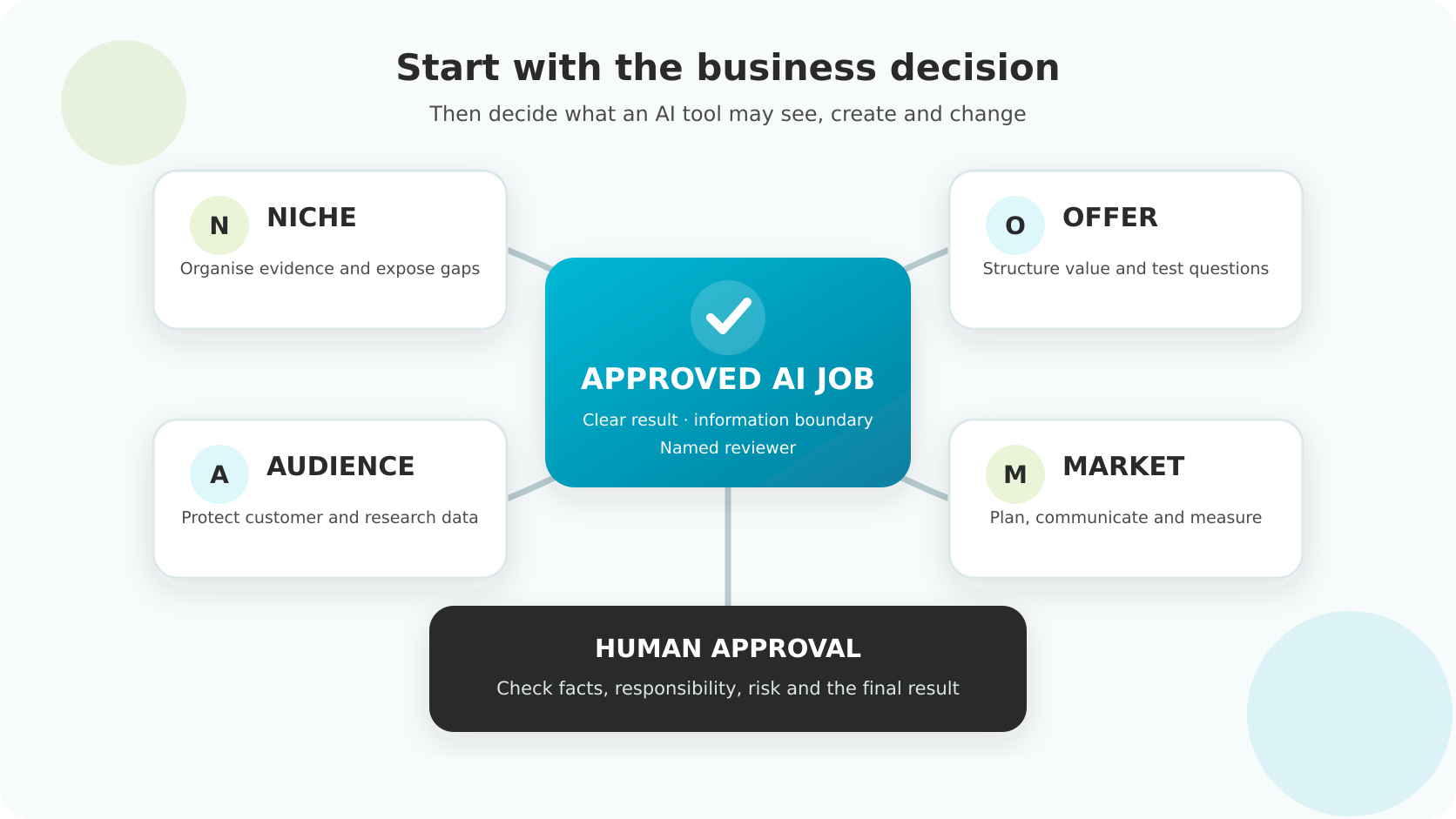
Four questions cover most of the ground, and they line up with the four decisions inside any small business: the niche, the offer, the audience and the route to market. If a tool cannot be attached to one of them, it is probably solving a problem the business does not have yet. Each question narrows the field of AI tools for small business down to the ones with a job to do.
Niche
Organise research and compare repeating problems. The evidence still comes from the market.
Offer
Structure features against buyer outcomes. Promises and prices stay with the owner.
Audience
Handle contact and customer information only inside an approved boundary.
Market
Research, planning, follow-up and reporting, each with a named human check.
Does the tool help with the niche decision?
AI is genuinely good at handling the material around a niche decision. It can organise research you have gathered, compare problems that keep repeating across enquiries, summarise evidence you supply, and expose gaps that still need investigating.
It cannot prove that demand exists. Demand is established by real market evidence: people paying, enquiring, searching or committing time. A summary of your own assumptions, produced quickly and formatted neatly, is still a summary of your own assumptions.
Does it strengthen the offer?
AI can help structure an offer, set features beside the outcome a buyer actually wants, and produce the list of questions that still need testing with real buyers. That is useful work, and it is faster than doing it on paper.
The promises, prices, delivery and claims remain yours. You are the one who has to honour them, so you are the one who signs them off.
Does it handle audience information safely?
This is the question most often skipped, and the one with the longest tail. Before any of the following is pasted, uploaded or connected, check what the provider does with it:
- customer data and account records
- email addresses and contact lists
- private messages and support conversations
- uploaded documents, contracts and invoices
- research interviews and recordings
- commercially confidential information such as pricing models or unpublished plans
Read the privacy notice and the data-use terms before personal or confidential information goes anywhere near a tool. Look for how long submissions are kept, whether they are used for training, where they are processed, and how you would delete them. The Information Commissioner’s Office guidance on AI and data protection sets out the principles a UK business is expected to work to, covering accountability, transparency, lawfulness, accuracy, fairness, security and data minimisation.
Does it improve the route to market?
This is where most small businesses see the first honest saving. Search research, content planning, email follow-up, lead sorting, routine customer communication and reporting are all repeatable jobs with checkable output.
Content is usually the safest place to start, because a draft can be read before anyone sees it. The workflow for that sits in a separate guide to AI tools for small business in content marketing, which covers the order of jobs and the quality check to run before publishing.
How to classify an AI job by risk
Risk is easier to judge by the job than by the tool. Most AI tools for small business can handle low-risk work safely, so it is the job that sets the control rather than the software. Three levels are enough for a one-person business.
| Level | Typical work | Control required |
|---|---|---|
| Low risk | Formatting supplied notes, creating internal checklists, brainstorming headings, sorting non-confidential information, producing a first draft from an approved source. | A quick read before use. No customer or confidential information. |
| Medium risk | Drafting customer emails, summarising internal documents, recommending marketing actions, generating public claims, handling unpublished business plans. | Human review before anything leaves the business, plus approved information handling and an approved tool. |
| High risk | Legal, tax, medical or financial decisions, employment decisions, processing sensitive personal information, sending unreviewed customer communications, changing live systems or financial records, making binding promises. | May require qualified professional advice, and may be unsuitable for the tool you have chosen. Treat as out of scope until that is settled. |
The table is a working aid for deciding where human review belongs. It does not replace a legal, security or data-protection assessment.
The same logic sits behind published risk frameworks. The NIST AI Risk Management Framework is built on identifying, managing and reviewing AI risks rather than trusting a tool by reputation. It is voluntary guidance from a United States standards body, not UK law, so read it for the structure rather than for compliance.
Choose the first job to give AI
The safest place to begin is a repeatable job with clear inputs, a checkable output and a person responsible for the final decision. Which Jobs Should You Give to AI First? helps you identify that starting point without buying another tool first.
- compare suitable business jobs
- spot where human review is still needed
- leave with one practical starting decision
Access is immediate. Enter your email address and the result is sent to you.
Which AI tools for small business should be approved?
Approval is a short, repeatable process. It takes about twenty minutes per tool and it replaces the vague feeling that something is probably fine.

Which AI tools for small business should be approved?
- Name the exact job.
- Identify the information the tool will receive.
- Check how the provider stores and uses submitted information.
- Decide whether the output can create harm if it is wrong.
- Name the person responsible for checking it.
- Test the process using non-sensitive information.
- Record the approved use.
- Set a review date.
- Document how access will be removed if the tool is abandoned.
Run that list and the search for the best ai automation tools becomes a much smaller question. The best tool is the one that performs an approved job reliably, inside your budget, within your skills and inside your information boundaries. A tool with fewer features that passes every step is worth more than a stronger one that fails step three.
Adoption figures suggest this is now a mainstream question rather than an early-adopter one. The Office for National Statistics reported that 28% of businesses with 0 to 9 employees were using at least one AI technology in June 2026, with improving business operations the most commonly reported use, and with difficulty identifying business uses, cost and a lack of expertise reported as barriers. The ONS research into AI tools for small business use gives the full survey scope.
A one-page AI policy for a small business
This is the template I would hand to any one-person business. It fits on a single page, it is written in plain English, and it can be reviewed in ten minutes. Adapt the wording and keep the twelve headings.
AI use policy, one page
- Purpose. Why the business uses AI, and the result it expects.
- Approved tools. The named tools and accounts that may be used, and nothing else.
- Approved uses. The specific jobs AI may be given, written as jobs rather than as topics.
- Prohibited information. What must never be entered, including customer records, payment details, health information and anything held under a confidentiality agreement.
- Human review. Which output must be read and approved by a person before it is used or sent.
- Accuracy and source checking. How facts, figures and quotations are verified, and against which source.
- Copyright and ownership. How material is checked for third-party rights before publication, and who owns the finished work.
- Disclosure. Where the business says that AI assisted with a piece of work, and where that is unnecessary.
- Access and passwords. Who holds the logins, where they are stored and how access is removed.
- Incident reporting. What to do when something goes wrong, and who must be told.
- Review dates. When the policy and each approved tool are checked again.
- Final responsibility. The named person accountable for output that leaves the business.
Written down once, it gives every one of the AI tools for small business you approve the same boundary. A policy on a page does not create legal compliance on its own. It records decisions, so the same question does not get answered differently twice.
The wider commercial decisions around an evergreen system sit outside a tool policy. The 14 Fs of Evergreen Business Success is a way to test those decisions before more of the business is automated. Where generic AI writing is the concern, the Safe Word List covers the language habits worth removing before anything is published.
Build your one-page AI policy
Fill in the seven fields and the builder writes the policy in plain English. Nothing is sent anywhere and no email address is required.
AI policy builder
This is a practical starting template, not legal advice. Check the finished policy against the laws, contracts and professional duties that apply to your business.
Your generated AI use policy
What to do when AI gets something wrong
Most incidents are small, and most are caught by the review the policy already asks for. The two below show the difference between an error that costs an hour and one that needs a recorded response. Both are the kind of thing AI tools for small business produce occasionally, whatever the provider promises.
Harmless. An AI tool drafts a marketing email that includes a statistic the source material does not support. The human review catches it before publication. The claim is cut, the source is checked, and the prompt is changed so figures must be quoted from a named document.
Risky. A customer document containing personal information is uploaded to an AI tool that has not been approved. Nothing has been published, but personal data has left the approved process, and the provider’s retention terms have not been checked.
The second case is why the incident steps are written down in advance. A decision made while worried is rarely the decision you would have chosen calmly.
- Stop the processPause the workflow before more information or output is created.
- Preserve a recordKeep what was entered, what came back and the time it happened.
- Remove accessRevoke logins, connections and integrations where that is possible.
- Identify what is affectedName the information or output involved, and who it concerns.
- Follow your procedureApply the data, security and reporting steps the business already has.
- Get professional adviceWhere the incident may have legal consequences, take qualified advice.
- Revise before restartingChange the policy or the workflow, then restart the process.
Recording the incident matters as much as fixing it. The record is what stops the same gap being rediscovered in six months.
The rule I now use before adding any new tool
Thirty years of watching software arrive ahead of the decision has made me slower to sign up and quicker to write things down. Before a new tool gets anywhere near my business, it has to answer five questions.
- Which job will it do?
- Which NOAM decision does it support?
- What will it be allowed to see?
- Who checks the result?
- What measurable improvement should it create?
If I cannot answer all five, the tool is interesting rather than useful, and interesting can wait. The rule has cost me a few enjoyable afternoons of experimenting. It has also kept customer information inside the process it belongs to, which is the trade I would make again.
That is the whole argument of this article in one habit. The technology keeps changing. The business still needs to know what the tool is being trusted to do, which is why the right AI tools for small business are defined by the job they perform safely and reliably rather than by their popularity or their feature list.
A useful AI system begins with a clear business decision. The subscription comes afterwards.
Find the decision underneath the tool
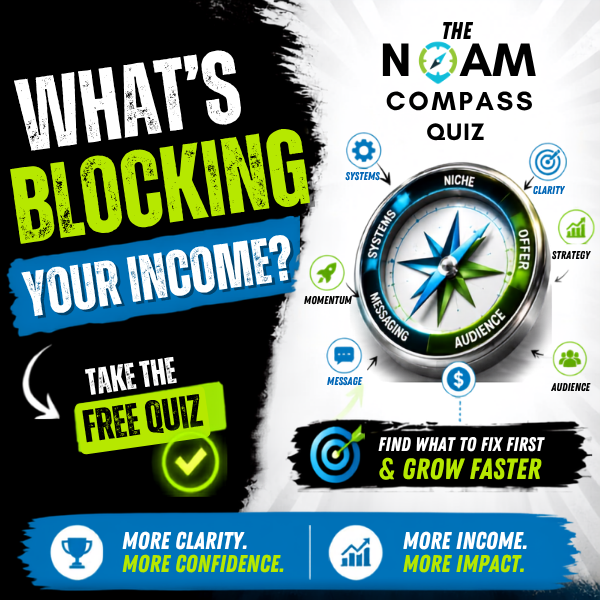
An AI tool can only support the business decision underneath it. The NOAM Business Compass asks six questions and shows whether the next job belongs in Niche, Offer, Audience or Market.
The quiz opens in a new tab, asks six questions and returns the area to work on next, with a short explanation of why. It is a diagnostic, not a promise of a particular result.
Sources and further reading
- Office for National Statistics, artificial intelligence in UK businesses, 2023 to 2026. Used for the 28% adoption figure among businesses with 0 to 9 employees in June 2026, the most common reported use and the reported barriers. Last checked 9 September 2026.
- Information Commissioner’s Office, guidance on AI and data protection. Used for the data-protection principles named in this article. The page states the guidance is under review following the Data (Use and Access) Act. Last checked 9 September 2026.
- National Institute of Standards and Technology, AI Risk Management Framework. Voluntary guidance, not UK law, used for the principle of identifying, managing and reviewing AI risks. Last checked 9 September 2026.
- PassivAi®, AI tools for content marketing. The content workflow referenced in the route to market section.
Kerry’s experience and the rules drawn from it are clearly marked as personal judgement. The figures, principles and frameworks above belong to the organisations that published them, and changing guidance should be checked at the source.

Kerry Greener
Founder of PassivAi®. Began working with commercial websites in 1995 and has 30 years of hands-on experience across websites, digital marketing, business development and automation. Created PassivAi® to help one-person businesses use AI and evergreen systems more practically.
More about PassivAi.
Free diagnostic
NOAM Business Compass
Six questions that place the real gap against Niche, Offer, Audience or Market, so the next job is the right one rather than the next tool.
FIND MY NOAM STARTING POINT
Free tool
Which jobs should you give to AI first?
Compare suitable business jobs, see where human review is still needed and leave with one practical starting decision.

PassivAi Infinity Lab
A free community for one-person businesses working out which jobs to hand to AI and which to keep.
Join the community