FOLLOW PASSIVAI YOUR WAY
RSS is a free way to follow websites without joining another email list or remembering to check for updates. Choose an RSS reader once and new PassivAi articles will appear there automatically.
RSS is free. You can stop following the feed whenever you like.
FIND YOUR PATH
Compare options. Audit your ideas. Follow the path.
BEFORE YOU CHOOSE
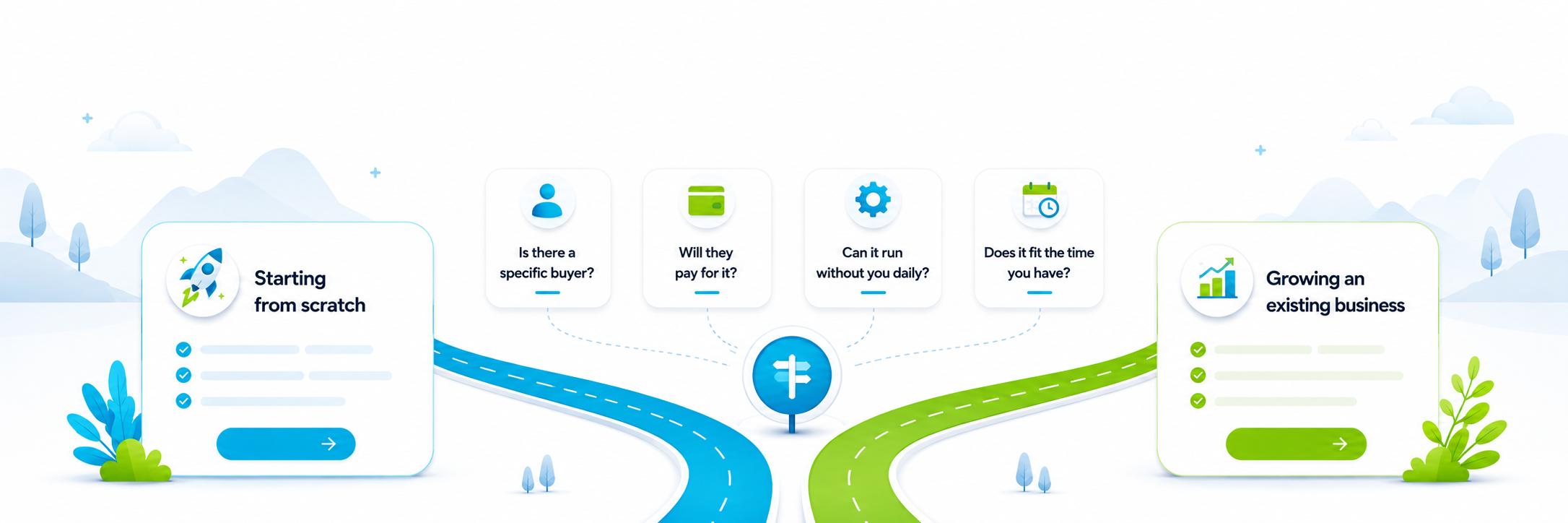
Choosing the best business to start means testing an idea before committing time or money to it. A good idea on paper and a good business are not always the same thing. Test it against these four questions.
A business that serves “anyone who wants to earn online” is harder to sell than one that solves a named problem for a named type of person.
Real demand shows up as people already searching, asking, or spending money on a version of this problem, not just interest once shown a finished product.
Trading hours for money has a ceiling. A business built around a repeatable offer, a digital product, or a system can keep earning after the initial work is done.
The right business for a spare five hours a week looks different to the right business for someone leaving full-time work. Plan around real capacity, not ambition.
The LIST 100 Digital Product Offer Stress Test gives an idea 100 real checks before any time gets spent building it out.
Stress-test this idea →WHY THIS MATTERS
Private-sector businesses trading in the UK at the start of 2025.
Of the UK’s 5.64 million small businesses employ nobody apart from the owner.
Business births and deaths recorded in 2024.
Five-year survival rate for businesses born in 2019.
One-person and home-based businesses are not a fringe option. They make up most of the UK’s small business population, and the survival figures make the case for testing an idea properly, before spending time or money building it out in full.
↑ Back to top
THE NUMBERS
Before deciding an idea is worth building, work out whether the maths adds up.
What will one customer pay?
What does delivery actually cost?
How many customers are needed each month to make it worthwhile?
TRY IT
A calculator like this will not replace a proper set of accounts. It exists to catch an idea that cannot make money before any time gets spent on it.
↑ Back to topTWO STARTING POINTS
Choosing the best business to start depends on whether you are building something new or improving something that already exists. Pick the path that matches your situation.
Starting from scratch
A sequence for choosing a niche, shaping a first offer, and getting a manageable plan in place without guessing at every step.
Start a business from home →Growing an existing business
Practical ways to market a small business online, choose the right tools, and turn existing customers and content into steady demand.
Market an existing business →FOR THE COMPLETE BEGINNER
Starting with no existing business, brand or customer base rewards a clear sequence over a burst of activity. These resources cover the order that tends to work when choosing the best business to start from home.
Online business opportunities from home lays out the main routes side by side, so an idea can be chosen with evidence instead of guesswork.
The NOAM Business Compass asks six questions and identifies which decision, niche, offer, audience or market, is worth fixing first.
How to start a home-based business sets out the correct sequence, from choosing a niche through to a first working offer.
FOR THE ESTABLISHED OWNER
For an established business, the best business to start next is often no business at all: better visibility and a stronger system, not a new idea. These resources focus on marketing, AI tools and getting found consistently.
Online marketing for small business covers where to focus first, from content and search to paid routes and referrals.
The PassivAi Sales System shows where AI genuinely saves time inside an existing business, rather than adding another tool to learn.
The NOAM Business Compass works for established owners too, pointing at whichever of the four decisions is holding growth back.
QUESTIONS

There is no single best business to start. The businesses that get off the ground fastest tend to be built around a skill you already have, a narrow buyer you can describe in one sentence, and a first offer that can be delivered without new equipment or staff.
There is no single easiest option. The businesses that get off the ground fastest tend to be built around a skill you already have, a narrow buyer you can describe in one sentence, and a first offer that can be delivered without new equipment or staff.
Describe the offer clearly, then ask a small number of real prospects to pay a deposit, join a waiting list, or book a paid pilot. A payment or a booking says far more than a compliment.
Yes. Many home businesses start this way. Choose an offer that fits the hours actually available each week, and be realistic about how long the testing stage will take before it needs to earn.
A sole trader structure is simpler to set up and suits most people testing a first idea. A limited company separates personal and business finances more formally. Either way, take advice on which structure suits your situation.
Often very little. A landing page, a simple form and a way to take a deposit or payment can be enough to test whether people will buy. Spend on building only once that evidence exists.
An offer that can be delivered the same way each time, through software, templates, recorded training or a documented process, is easier to automate than one that depends entirely on live, personal judgement.
Often, yes. Look at the parts of the service that get repeated with every client and consider whether a template, a recorded course or a productised version could deliver the same result with less personal time.
Long enough to collect real evidence, usually a small number of weeks with a genuine offer in front of real prospects, rather than months of planning with no one outside the room seeing it.
Six questions. From Idea to Income or Business Boost. Personalised Audit.
Start the NOAM Framework Compass