

Start up costs for business are the sums that must be paid before an offer can go on sale, plus the sums that keep it on sale. Four groups: one-time setup, monthly fixed costs, the cost of delivering each sale, and the cost of finding each buyer.
Add them up and a price floor appears. That floor is where pricing starts, not where it ends, because the floor says what the offer costs you and says nothing about what it is worth to the person buying it.
Key takeaways
- Separate one-time setup spending from monthly costs and from the cost of each sale. Start up costs for business behave differently as sales rise, and mixing them produces a price that looks fine until volume changes.
- An unknown cost gets a written allowance and a date, never a zero. Acquisition cost is the one usually left out, and it is often the largest.
- Markup is added to cost. Margin is taken out of price. The same percentage gives two different prices.
- A calculator gives a planning figure. A suitable buyer paying for a real version gives evidence.
Start up costs for business: what has to be paid before your first sale
The problem shows up at the moment of setting a price. The offer is built, the page is nearly ready, and the number gets picked by looking at somebody else's website. It feels defensible because it matches the market. It is not defensible, because that competitor has different costs, a different list and a different amount of support built into their price.
A price that covers nothing is a hobby. A price built only on costs ignores the buyer. Both numbers are needed, and the cost number comes first because it is the one you can actually know.
The way out is dull and quick. Write down every sum the offer causes you to spend, sort those sums into four groups, and you have a cost per sale you can put a price around. The action for today is the list. Nothing gets priced until the list exists.
Start up costs for business, sorted into four groups
Two details are worth getting right.
Count your own hours. Put them in group one at the rate you would charge a client. An offer built in unpaid evenings still consumed something.
Assets are not the same as costs. A camera or a laptop keeps its use across many products, so put it in group one at the share this offer uses rather than the whole purchase price.
Start Up Loans makes the same separation in its guide on how to calculate start up costs for business, between setup costs, assets and the ongoing costs that follow.
A consultant runs the same piece of work for every new client: a structured review of their positioning, delivered as a written document and a short call. It takes her two days. Clients pay for it inside a larger project.
She wants to sell that same deliverable online, as a product, without the two days. The intake becomes a form, the document becomes a template, the call becomes a recorded walkthrough. This example runs through the rest of the article, and every amount in it is illustrative.
What to do when a cost is unknown
Some numbers are not available on the day you need them. Advertising cost per sale is unknown until an advert runs. Support time is unknown until real buyers ask real questions. Refund rates are unknown until there are enough sales to have a rate.
Three rules keep an unknown from quietly becoming a zero.
- Get a real figure where one exists. Subscription prices, payment fees and any registration fee are published. Look them up rather than estimating them, and check the date on what you find.
- Write an allowance for the rest, and label it. An allowance is a decision, not a measurement. Put the number in the sum, then put the word estimate next to it so nobody later mistakes it for a fact.
- Give every allowance a replacement date. The first test produces real numbers. The allowance exists only until then.
A cost left out of the sum does not stop happening. It just stops being visible until the bank balance shows it.
How much cash the business needs while it tests demand

Price is one question. Surviving long enough to find the right price is another. The sum is short: one-time setup, plus monthly fixed costs multiplied by the number of months of testing, plus whatever the test itself costs to run.
For the consultant, illustratively: setup of £1,200, monthly costs of £60, three months of testing and £300 set aside for the test. That is £1,680 before a single sale is counted. Sales during those months reduce the number, but planning on them is planning on the thing being tested. Start Up Loans frames this as the funding needed until a business covers its own costs, and it also makes the point that revenue is not profit: sales alone do not show what is left after the costs come out.
That figure decides whether the question is funding at all. A test of this size is usually paid for out of ordinary trading money and a few subscriptions. Funding to start a business becomes a real question at a different scale, when stock, equipment or staff are involved. Loans for business start up exist, and the terms, amounts and eligibility change, so they are worth reading on the lender's own pages rather than in an article. Borrowing is not a requirement for testing a small online offer, and a loan taken before there is evidence of demand buys time rather than answers.
Registration, record keeping and consumer selling rules sit alongside the money. What applies depends on the structure chosen and on what is being sold, and the current requirements to start a business are set out on GOV.UK. Check the fees there rather than in any guide, including this one, because they change. The tool side of things is covered separately in start up costs for business: which tools earn their place, which is where the monthly column usually gets out of hand.
A provisional price floor, and the plain-English formula behind it
The floor is one number: what one sale must bring in for the offer to cover its costs and leave the contribution you decided on. Four steps, in words, before the calculator does them in figures.
- Spread the setup. Divide one-time setup by the number of sales you tentatively plan to recover it over. Forty sales, not four hundred, if forty is what you can honestly picture.
- Spread the monthly. Divide monthly fixed costs by a conservative number of sales per month. Conservative matters here, because an optimistic sales figure hides the cost rather than covering it.
- Add the costs of the sale itself. Delivery, payment fees and support for one buyer, plus the cost of finding that buyer.
- Add your contribution. As a margin taken out of the price, or as a markup added to the cost. Say which, because the two give different prices.
Markup and margin are the place this goes wrong most often. A 40 per cent markup on a cost of £50 gives £70. A 40 per cent margin on the same cost gives £83.33, because the margin is a share of the price rather than a share of the cost. Neither is more correct. Using one label and the other formula is what produces a price that never quite works.
Where a provisional price floor comes from
Three kinds of cost, each divided by something different, then added up per sale.
Provisional price floor calculator
Put your own figures in. Everything updates as you type. The intermediate lines show how the floor was reached, so you can see which assumption is carrying the most weight. This is arithmetic on the numbers entered, not financial advice, and it cannot predict demand.
A planning figure only. Check it against buyer value, cash flow, any tax treatment that applies and evidence from real sales before using it.
- Setup, spread over your planned sales£30.00
- Monthly fixed, spread over your monthly sales£3.00
- Delivery and transaction, per sale£4.00
- Acquisition, per sale£12.00
- Cost of one sale£49.00
- The same costs as a markup instead£68.60
Run the consultant's illustrative figures and the floor lands near £82 a sale. That is the number underneath every pricing decision that follows. Below it, each sale costs her money. At it, she covers costs and her stated contribution and nothing more. Above it, there is room to fund support, proof and the next product.
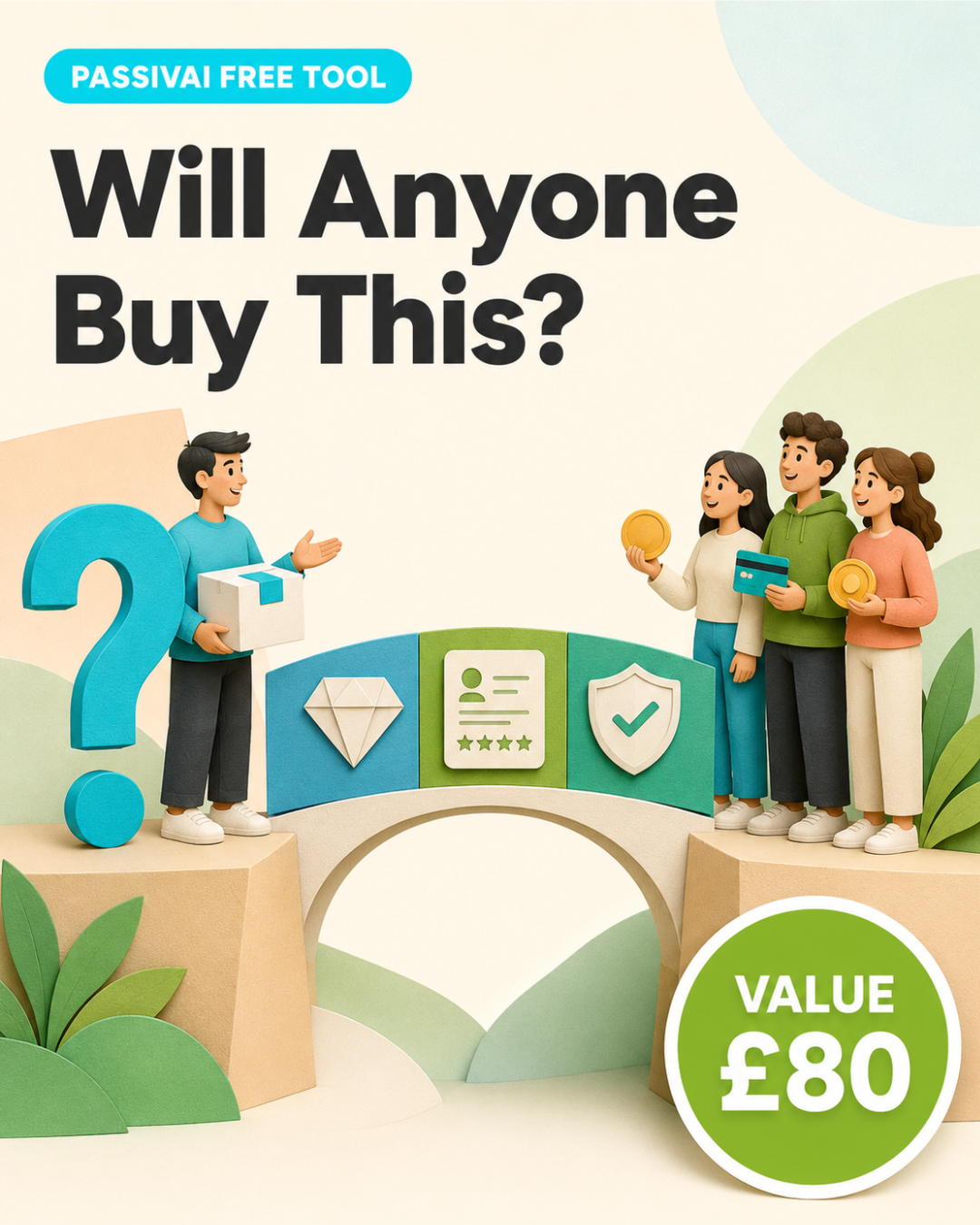
Find out whether your offer has buyers before you spend on the launch
Sixteen buying-decision checks against your own offer, in a few minutes. It scores the parts that make a purchase easy to say yes to, names the weakest part, and gives you wording and a small paid test to run.
- Five separate scores on the buying decision, not one vague verdict
- The main hesitation a buyer is likely to have, in your own subject
- Wording you can use, plus the paid test that produces evidence
What the buyer is actually paying for
The floor says what the offer costs. Nothing in it says what the offer is worth to the person holding the card. That comes from the result they get, the work they no longer have to do, and how believable both look from outside.
Value stacks with invented prices next to each benefit are worthless for this. Nobody buys because a bullet claimed to be worth £500. What does work is stating what the buyer gets in each of four honest categories, then asking whether the price looks sensible beside them.
A finished positioning document for their own business, written in their words, ready to use on a sales page. Named as an end state, not as an activity.
The intake questions, the document template, the worked example and the recorded walkthrough. Each one saves a specific piece of work.
Stated precisely: email answers within three working days, or a monthly group session, or nothing at all. Vague support is a cost to you and no comfort to them.
A sample of the actual output, the number of times the method has been run, and a plain refund term. Proof is the part that carries the price.
Notice which of those four rises with price and which does not. The outcome barely changes. Support and evidence change a great deal, and they are where the cost of a higher price actually sits.
The alternatives a buyer compares you against
Nobody judges a price on its own. They judge it against the other ways of solving the same problem, including doing nothing. Start Up Loans makes the same point about assessing direct and indirect competitors on price and quality, not price alone. Scope and outcome belong in that comparison too, because a cheaper thing that leaves the job unfinished is not really cheaper.
| Route | What the buyer does | What they end up with | Their effort | Typical price |
|---|---|---|---|---|
| Do nothingThe most common choice | Carries on with the current wording | No change, and the same problem next quarter | None | Free, and it costs sales |
| Free articles and videosSelf-assembled | Reads widely and works out the order themselves | Ideas, rarely a finished document | Many hours, spread over weeks | Free |
| A template on its ownUnguided | Fills in a blank structure | A document as good as their own thinking on the day | An afternoon | Low |
| This productGuided, self-serve | Answers structured questions and follows the walkthrough | A finished document, with a worked example beside it | Two to three hours | Middle |
| Hiring a consultantDone for them | Books time and turns up to a call | The same document, written by somebody else | Almost none | Many times higher |
Read down that table and the product's real competitor becomes obvious. It is not the consultant. It is free articles and doing nothing, and the way to beat both is a finished result rather than a lower price.
One offer, three prices, and what genuinely changes
Here is the same underlying deliverable at three illustrative prices. The subject matter is identical in all three. What differs is scope, delivery work, support and proof, and those differences are real work rather than packaging.
£49
Self-serve, no support
- Template, intake questions and recorded walkthrough
- One sample output to follow
- No support, stated plainly on the page
- Proof: the sample itself
£199
Guided, with answers
- Everything above, plus worked examples for three business types
- Email answers within three working days
- A monthly group session
- Proof: two documented before and after examples
£799
Reviewed by a person
- Everything above, plus a 90 minute review of their own draft
- Written feedback and one revision
- Eight weeks of email access
- Proof: named examples and a clear refund term
Three things follow from that. Support is the cost that scales with price, which is why a big promise at a small price runs a business out of cash rather than out of customers. Proof has to grow with price, because a stranger spending £799 needs more than a sample. And the top version is not a product any more, it is her time with a template attached, which caps how many she can sell.
The £49 version needs roughly sixteen sales to match one £799 sale, and each of those sixteen has an acquisition cost. Put the three through the calculator above and the middle version usually has the most room between the floor and the price. That is the version worth testing first.
A price test small enough to run this month

Everything so far is planning. This is the part that produces evidence, and it only works if it is small, time-bounded and decided in advance.
The plan, in six lines
One offer, one price
The middle version at £199. Two prices at once tells you about the choice, not the price.
A defined audience
Named in advance: the people already on her list who have asked about positioning. Not the internet.
One purchase action
A working checkout link. Interest is not evidence. Payment is.
Fourteen days
Long enough to reach everybody twice, short enough to force a decision at the end.
Costs recorded daily
Every advert, every fee, every hour of support. This is where the real acquisition cost comes from.
A review date, set now
Day fifteen. Three outcomes decided in advance: keep the price, change the scope, or stop.
At the review, replace every allowance in the calculator with the figure the test produced, starting with acquisition cost, and read the floor again. Start up costs for business look different once real numbers replace assumed ones, and that second reading is worth more than the first.
One warning about what the test can tell you. Kind words are not evidence. Sign-ups are weak evidence. A suitable buyer paying full price for a real version is the only strong evidence, which is why the purchase action has to be real from day one.
Working out the tax treatment, record keeping and invoicing that go with those first sales is a separate job, and the current rules sit on GOV.UK rather than in an article. Check them there before the test rather than after it.
Turning a workable price into an offer people understand
By this point the numbers exist: a cost per sale, a floor, a version worth testing and a plan. The remaining work is the buyer's side of it. The promise, the buyer it is for, the pricing logic and the proof all have to say the same thing, in the same words, everywhere the offer appears.
That is the job COREMAGIC™ PRO does. Its own product page describes what it produces, and it is worth reading before buying.
 Primary route
COREMAGIC™ PRO, the core offer generator
One structured 8-part intake feeds a personalised 12-part dashboard that holds your buyer segments, core problems, promise, proof points, pricing logic, differentiators and sales hooks in one linked document.
- One consistent voice. Linked AI agents that keep the positioning, hooks and copy the same because they work from the same intake.
- No rewriting from scratch. A reusable console to return to when the price, the bonus or the buyer changes.
- An end to the blank page. Built-in copy prompts that turn the dashboard into headlines and bullets.
The button opens the COREMAGIC™ PRO product page in the PassivAi® shop, where the full description, the walkthrough video and the current price are listed. One-time purchase, currently £127, reduced from £197.
Turn my costed price into an offer buyers getStart up costs for business are only half of a price. They tell you the floor, and the floor keeps you solvent while you find out what the offer is worth to somebody else. The other half comes from buyers, in the only currency that counts as evidence, and it arrives faster than most owners expect once there is a real thing to buy. The task after that is naming the specific benefits and pressure-testing the offer, which is what LIST 100 is built for.
Frequently asked questions
What are start up costs for business, in plain terms?
They are the sums that must be paid before an offer can go on sale, plus the sums that keep it on sale. One-time setup spending, monthly fixed costs, the cost of delivering each sale, and the cost of finding each buyer.
What are the requirements to start a business selling online in the UK?
Registration, records, tax and the rules for selling to consumers depend on the structure chosen and on what is being sold. GOV.UK sets out the current requirements to start a business and is the source to check before spending, because those rules and fees change.
Do you need funding to start a business selling a digital offer?
A small digital test is usually built from setup costs and a few monthly subscriptions, so borrowing is rarely needed to find out whether anyone will buy. Funding to start a business is a separate decision about growth, and it should follow evidence of sales rather than replace it.
What is the difference between markup and margin?
Markup is added to the cost. Margin is taken out of the price. A 40 per cent markup on a cost of £50 gives a price of £70. A 40 per cent margin on the same cost gives £83.33. The same percentage produces two different prices, which is why the label matters.
Does a price calculator prove buyers will pay that price?
No. A calculator produces a planning figure from the numbers entered. It cannot show demand. Only a suitable buyer paying for a real version of the offer does that.
How do you price an offer when the acquisition cost is unknown?
Set a written allowance, label it as an estimate rather than a measurement, and put a date on replacing it with a figure from a real test. Treating an unknown acquisition cost as zero produces a price floor that quietly excludes the biggest cost in most small online businesses.
How long should a first price test run?
Long enough to reach a defined audience and short enough to force a decision. Two weeks with one offer, one price, one purchase route and recorded costs is usually enough to show whether people act.
Should the first price be low to attract buyers?
A low price is a decision about scope as well as revenue. It has to be matched by a smaller promise, lighter delivery and less support, or each sale costs more than it brings in. Cheap with a big promise is the combination that runs a business out of cash.
Sources and further reading
- Start Up Loans, how to calculate start up costs for business: separates setup costs, assets and ongoing costs, and the funding needed until a business covers its own costs.
- Start Up Loans, revenue versus profit: why sales alone do not show what is left after costs.
- Start Up Loans, market research techniques: assessing direct and indirect alternatives on price and quality.
- Start Up Loans, programme details: current loan amounts, rates and eligibility for start up borrowing, which change and should be read on the lender's own pages.
- GOV.UK, set up a business: the current requirements to start a business, including registration, records and fees.
Last checked: 21 September 2026. Government fees, finance terms and eligibility rules change, so check each linked source before relying on a figure. Every amount in the representative example is illustrative. Nothing here is financial, tax or legal advice.

Kerry Greener
Founder of PassivAi. Working with commercial websites since 1995, and thirty years of building businesses, websites and online marketing campaigns for hundreds of different companies.
More about PassivAi.
Free check
Will anyone buy this?
Sixteen buying-decision checks, five scores, and the one part of the proposition to strengthen before spending on promotion.

PassivAi Infinity Lab
See what other owners actually priced their offers at, what sold, and what it cost them to get each sale. Free to join.
See real prices that sold