

What does a four-leaf clover mean?
The best-known meaning is luck. A four-leaf clover is unusual enough to feel special when it appears, and over time that rarity became connected with good fortune.
But the symbol has gathered other meanings too. One widely repeated interpretation gives each of its four leaves a value:
Faith
Trust in something that cannot always be proved or seen yet.
Hope
The expectation that something better may still be ahead.
Love
Connection, affection and the people who give success its meaning.
Luck
The unexpected opportunity, meeting or moment that arrives without being planned.
The history of the four-leaf clover as a lucky symbol

Written references connecting four-leaved grass with good fortune go back several centuries.
In 1620, English writer John Melton included a belief in his work Astrologaster that someone who found four-leaved grass would shortly afterwards find something good.
That matters because it shows that the association between the four-leaf clover and unexpected good fortune is far older than modern greetings cards, lucky charms or St Patrick's Day merchandise.
The spiritual meaning of the four-leaf clover
Spiritual symbolism is rarely tidy. Meanings build slowly as stories are told, repeated and changed.
The four-leaf clover has been linked with protection, intuition, good fortune, unseen possibilities and the ability to notice something others may pass by.
That last meaning is particularly interesting.
Nineteenth-century folklore recorded a belief that carrying a four-leaf clover could allow someone to see fairies. Read literally, it belongs to folklore. Read symbolically, there is something rather lovely in it.
The unusual opportunity. The person worth speaking to. The idea hidden inside years of experience. The route nobody else noticed because everybody was looking at the same three leaves.
That idea sits rather neatly beside PassivAi
PassivAi is built around recognising useful knowledge that already exists, then shaping it into an evergreen business asset.
Read the story behind PassivAi®Why four-leaf clovers became gifts
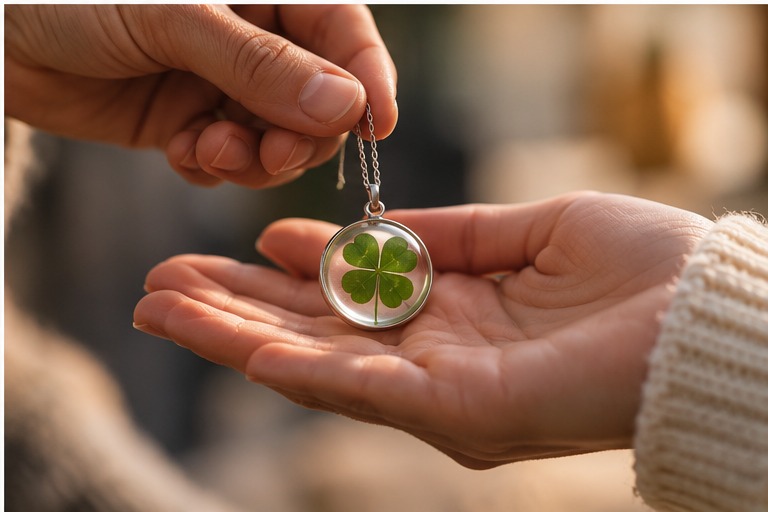
A lucky symbol becomes more powerful when it is given away.
By the late nineteenth and early twentieth centuries, four-leaf clovers were appearing on postcards, greetings, charms, pendants and keepsakes. Their role was simple. They carried a wish from one person to another.
A four-leaf clover says something without needing many words
Good luck.
I hope this works out for you.
I hope something unexpected goes your way.
I thought of you.
That makes the four-leaf clover slightly different from a symbol of wealth or success.
It feels generous.
Luck is being wished upon somebody else.
Why the four-leaf clover matters to PassivAi
The four-leaf clover gradually became part of the way PassivAi messages are signed off.
At first, it was simply a symbol that felt right.
The more its history and meaning are considered, the more appropriate it becomes.
Building something of your own takes faith before there is evidence. It takes hope during the bits that refuse to behave. It needs love for the life, people or purpose you are building it around.
And yes, sometimes a little luck turns up at exactly the right moment.
But perhaps the most fitting part is the idea of noticing what others miss.
PassivAi is built around finding value that already exists in skills, experience, ideas and knowledge, then turning it into something that can keep working long after the initial effort has been made.
There is something rather four-leaf-clover-ish about that.
I hope something good finds you.
I hope you notice it when it does.
And I hope you pass a little of it on.
Perhaps luck is partly about noticing
A field of clover can look completely ordinary until one leaf makes somebody stop.

The four-leaf clover has survived for centuries because it gives shape to a feeling people understand instinctively.
Good things can arrive unexpectedly.
Opportunity is not always announced.
Small things can carry surprisingly large meanings.
And sometimes the difference between passing something by and finding something valuable is simply being willing to look a little closer.
Something useful to take away
The free Online Business Compass helps identify which of four business foundations deserves attention first. The personalised result and practical route are sent by email.
Take the free six-question CompassSources and further reading
- John Melton, Astrologaster, 1620. Historical reference to four-leaved grass and finding something good.
- The Folk-Lore Journal, Volume 5, 1887 . Recorded Cornish folklore concerning four-leaved clover and seeing fairies.
- New York Public Library: Four Good Luck Symbols to Ring in the New Year . Examples of clover imagery in historical postcards and greetings.
- McCord Stewart Museum collection records for early twentieth-century clover jewellery and symbolism.