
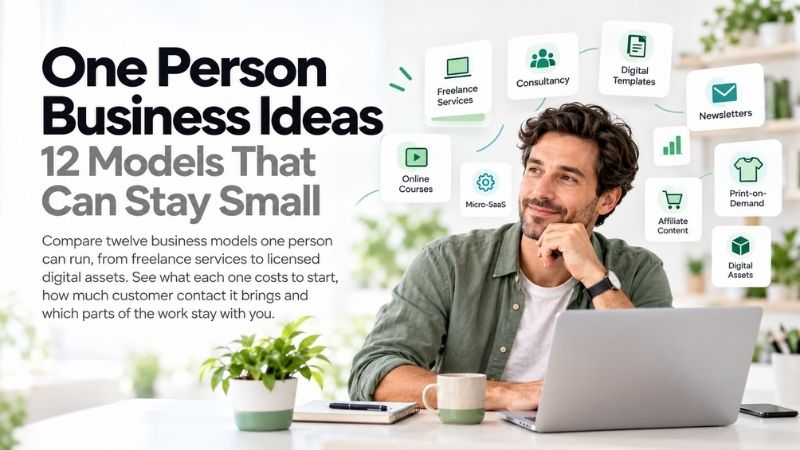
One person business ideas that can stay small include freelance and fixed-price services, independent consultancy, digital templates, online courses, niche information websites, paid newsletters, memberships, print-on-demand, affiliate content, micro-SaaS and licensing original digital assets. The right one depends on whether you want to sell your time, a repeatable service or something reusable, and how much customer contact and upkeep you are prepared to carry on your own.
This guide compares all twelve on what they sell, who pays, what each one asks of you and where the work stays with you however well you set it up. It does not quote earnings. Income depends on the market, the offer and the person running it, and anyone promising a figure without knowing those is guessing.
Key takeaways
- A business can stay small by choice. Three quarters of UK private sector businesses have no employees other than their owners.
- Selling your time, selling a repeatable service and selling something reusable behave very differently once you have customers.
- Needing little of the owner and needing little upkeep are two separate qualities. A paid newsletter needs no staff but needs you every week.
- Services are a practical route to first income. Reusable products usually need more upfront work and steady marketing before sales become regular.
- Narrow the one person business ideas to one model first, then check demand with a small paid test before building the full thing.
Which kind of one-person business do you actually want?
Wanting a one-person business is usually about control. Control over what you earn, which hours you work, where you work from and who you work with. The business model you choose decides how much of that control you really get.
You would be in large company. The Department for Business and Trade estimates that at the start of 2025 there were 5.7 million private sector businesses in the UK, and 4.3 million of them did not employ anyone aside from the owners.
Three in four UK businesses run without employees
UK private sector businesses at the start of 2025, by whether they employ anyone besides the owners.
- 4.27 million with no employees
Owners working alone or in partnership, plus companies with one employee assumed to be the working owner - 1.42 million employers
Businesses with at least one employee
The statistical category matters here. A “non-employing” business in these figures is one with no employees other than its owners. It includes sole traders, partnerships made up only of self-employed partners and companies with a single employee, who is assumed to be the working owner. It is a count of business structures, not a measure of how many hours those owners work or how much they earn.
Which brings up the more useful distinction. Some businesses stay small because one person owns and runs them, and the business is effectively that person’s working week. Others are designed so the owner is less directly involved in each sale: something is built once and sold repeatedly. Both can be one-person businesses. They feel completely different to run.
What makes a business suitable for one person?
A one-person business is one where a single owner handles, or arranges, everything the business needs: making or delivering what it sells, talking to customers, keeping the books, dealing with admin and finding the next sale. The owner may buy in help from freelancers or software, but there is no payroll.
For that to be sustainable, five things need to fit inside one person’s week:
- Operating costs low enough that a quiet month does not become a crisis.
- Delivery that one person can produce to a consistent standard.
- Customer communication at a volume you can answer well.
- Administration, including tax, invoices and records, that does not swallow the time meant for paid work.
- Income generation: a reliable way of finding the next buyer, which still has to happen while you are busy delivering for the last one.
A business with no employees can still be a full-time job and then some. A freelancer with a full diary is a one-person business. So is a membership owner answering member questions every evening. Having no staff tells you who does the work. It does not tell you how much work there is.
Owner independence
How far each sale depends on you personally being there. A recorded course can sell while you sleep. A consultancy cannot.
Low maintenance
How much upkeep the business needs to keep earning. A newsletter is highly independent of you per sale, yet needs a new issue every week.
Keep those two qualities separate when you compare ideas. Plenty of models score well on one and poorly on the other.
12 one person business ideas worth considering

The twelve models fall into three broad groups. Service-led businesses sell your time. Repeatable businesses deliver the same thing to many buyers, though someone still has to produce new material. Asset-led businesses sell something built once that can earn from many buyers over time.
The group tells you more than the individual idea. It shows how much of your week each sale takes, and whether income can arrive on days you do not work.
Sell your time
- Freelance specialist services
- Independent consultancy
- Income grows with
- Your hours and your rate
- Owner time per sale
- High
- Upfront work
- Low
Sell a standard offer
- Fixed-price services
- Online courses and training
- Paid newsletters Recurring
- Memberships Recurring
- Income grows with
- Buyers served by the same process or material
- Owner time per sale
- Medium
- Upfront work
- Medium, then ongoing
Sell something reusable
- Digital templates
- Niche information websites
- Print-on-demand
- Affiliate content
- Micro-SaaS Recurring
- Licensing digital assets
- Income grows with
- Reach, traffic and the size of your catalogue
- Owner time per sale
- Low
- Upfront work
- High, before regular sales
The groupings and assessments of these one person business ideas are PassivAi® editorial judgements, made to help you compare. They are not measured data. Examples are illustrative.
Choose any model below to jump to its full profile.
- 1. Freelance specialist servicesYour skilled time on a defined job
- 2. Fixed-price or productised servicesOne defined service at one set price
- 3. Independent consultancyExpert advice and decisions, sold to organisations
- 4. Digital templates and toolkitsReady-made files that save the buyer time
- 5. Online courses and specialist trainingStructured teaching towards one result
- 6. Niche information websitesArticles that answer specific questions
- 7. Paid newsletters and specialist publicationsRegular insight sold by subscription
- 8. Memberships and resource librariesOngoing access to resources and updates
- 9. Print-on-demand productsYour designs, printed only when ordered
- 10. Affiliate content businessesRecommendations that earn a commission
- 11. Simple software tools or micro-SaaSA small tool that solves one narrow problem
- 12. Licensing original digital assetsYour photos, music or fonts, licensed many times
1Freelance specialist services
You sell a skill by the job or by the hour: copywriting, bookkeeping, illustration, web development, translation, video editing. It is the oldest one-person business there is, and still the quickest way for many skilled people to turn ability into invoices.
- What it sells
- Your time and skill applied to a task the client defines.
- Who pays
- Small firms, agencies and individuals who need the skill now and then and do not want to hire for it.
- To start
- A skill people already pay for, a handful of examples of your work, a simple contract and a way to invoice.
- Main work
- Quoting, delivering each job, handling revisions and chasing payment.
- Finding customers
- Former employers and colleagues, referrals, LinkedIn, local networks and freelance marketplaces.
- Repeatability
- Low to medium. Each job is a little different, even when the skill is the same.
- Still needs you
- Nearly everything. When you stop working, the income stops with it.
- Where costs rise
- Marketplace fees, late payers and the point where demand exceeds your hours and you either turn work away or start subcontracting.
- Best suited to
- Someone with a marketable skill who needs income relatively soon.
2Fixed-price or productised services
A productised service is a service sold like a product: a fixed scope, a fixed price and a set delivery time. A website speed review, a CV rewrite or monthly bookkeeping for sole traders with up to a set number of transactions are typical examples.
- What it sells
- A standard outcome delivered the same way every time.
- Who pays
- Buyers who want certainty about what they get, what it costs and when it arrives.
- To start
- One clearly bounded deliverable, a written process, a page that explains it and a checkout or booking form.
- Main work
- Delivering to a checklist, handling intake and managing the occasional exception.
- Finding customers
- The same routes as freelancing, plus search, because a clearly named service is easier to find than a general skill.
- Repeatability
- Medium to high. The process repeats; your judgement on each case still matters.
- Still needs you
- Delivery, quality control and any case that does not fit the standard.
- Where costs rise
- Scope creep when limits are loose, and underpricing that only shows up once volume grows.
- Best suited to
- Freelancers who are tired of quoting every job from scratch.
3Independent consultancy
A consultant sells judgement: diagnosing a problem, recommending what to do and sometimes overseeing the change. The product is your experience, which makes it valuable and hard to hand over.
- What it sells
- Advice, analysis and recommendations based on experience in a field.
- Who pays
- Businesses and organisations with a budget for outside expertise.
- To start
- Recognised experience, a professional network and clear terms. Some clients will ask for professional indemnity insurance.
- Main work
- Sales conversations, meetings, analysis and writing up recommendations.
- Finding customers
- Your network, referrals, speaking and writing that shows how you think. Sales cycles can be long.
- Repeatability
- Low. A consistent framework helps, but each engagement is shaped by the client.
- Still needs you
- You are the product, so almost all of it.
- Where costs rise
- Insurance, contract negotiation and gaps between projects that have to be planned for.
- Best suited to
- Experienced specialists who already have a reputation people recognise.
4Digital templates and toolkits
Spreadsheets, planners, design templates, checklists and document packs. You build the file once and every buyer downloads the same thing.
- What it sells
- A shortcut: a working starting point the buyer would otherwise build themselves.
- Who pays
- Individuals and small businesses with a common, specific task.
- To start
- A template that solves a frequent problem, clear instructions, product images and a shop, either your own or a marketplace.
- Main work
- Building and testing the template, writing the instructions and creating listings.
- Finding customers
- Marketplace search, Pinterest, your own website and an email list.
- Repeatability
- High. One file serves every buyer.
- Still needs you
- Marketing, updates when the software it runs in changes, and buyer questions.
- Where costs rise
- Marketplace fees, copycat products and crowded low-price categories. Legal or financial templates carry extra responsibility for accuracy.
- Best suited to
- Organised people who already build their own systems and can explain them simply.
5Online courses and specialist training
Recorded courses, live cohorts or workshops that teach a skill or get a learner to a specific result. Recorded courses can be sold many times; live teaching behaves more like a service.
- What it sells
- A structured route from where the learner is to a result they want.
- Who pays
- Individuals building a skill and, for professional topics, employers paying for staff training.
- To start
- A result you can teach, a course platform, basic recording equipment and an audience or a way to reach one.
- Main work
- Planning, recording and editing, then launching, then updating the material as things change.
- Finding customers
- An email list, useful free content, webinars and partnerships with people who serve the same learners.
- Repeatability
- High for recorded courses, low for live teaching.
- Still needs you
- Student questions, updates and continuing marketing.
- Where costs rise
- Platform subscriptions, refund requests and topics such as health or money, where accuracy and claims need extra care.
- Best suited to
- Practitioners who can explain what they do clearly and patiently.
6Niche information websites
A website that answers the questions a defined group of readers searches for, earning from advertising, affiliate links or its own products. Readers usually pay nothing.
- What it sells
- Attention and trust, which are turned into income through ads, commissions or your own offers.
- Who pays
- Advertisers, affiliate programmes or readers who go on to buy something you sell.
- To start
- A domain, hosting, writing ability, real knowledge of the topic and patience.
- Main work
- Research, writing, updating older articles and keeping the site running.
- Finding customers
- Search engines, AI search tools, social platforms and an email list.
- Repeatability
- High once published. One article can be read many times without more work per visit.
- Still needs you
- Regular publishing and updating. Out-of-date content loses readers.
- Where costs rise
- Income can take a long time to build, and changes to how search engines show results can reduce visits without warning.
- Best suited to
- Patient writers with a long-term goal and a subject they will not tire of.
7Paid newsletters and specialist publicationsRecurring
A newsletter or publication that readers pay for, usually monthly or yearly. The best-known examples cover a narrow professional subject in more depth than general media.
- What it sells
- Regular, specialist insight that saves the reader research time.
- Who pays
- Readers who value the subject, often professionals or serious enthusiasts.
- To start
- A defined subject, a publishing platform that handles paid subscriptions and a schedule you can keep.
- Main work
- Researching and writing every issue.
- Finding customers
- A free tier, recommendations from other writers, social platforms and cross-promotion.
- Repeatability
- Delivery is automatic. The content is new every time.
- Still needs you
- Continuing editorial work. The schedule is a promise to paying readers.
- Where costs rise
- Platform fees and cancellations, especially after a missed issue or a dip in quality.
- Best suited to
- Writers with a specialist subject and a steady writing habit.
8Memberships and resource librariesRecurring
Members pay a recurring fee for access to a growing library of resources, regular updates and sometimes a community. Think lesson resources for teachers, or monthly templates for small-business owners.
- What it sells
- Continuing access, so the member does not have to find or make the material themselves.
- Who pays
- People with an ongoing need rather than a one-off problem.
- To start
- Enough useful material at launch to justify the first payment, a membership platform and recurring billing.
- Main work
- Adding new resources, answering members and, if there is a community, moderating it.
- Finding customers
- Free samples, an email list and content that shows the quality of the library.
- Repeatability
- Medium to high. Each resource serves every member.
- Still needs you
- Ongoing value and customer care. Members leave when the library stops improving.
- Where costs rise
- Community moderation time, billing queries and the steady work of replacing members who leave.
- Best suited to
- Someone who produces a steady flow of useful material and enjoys looking after people.
9Print-on-demand products
You create designs; a print supplier prints them on clothing, mugs, prints or stationery when an order comes in and ships it to the buyer. You hold no stock.
- What it sells
- Original designs on physical products.
- Who pays
- Consumers buying gifts or products for an interest they identify with.
- To start
- Original designs, an account with a print supplier and a shop.
- Main work
- Designing, creating listings and marketing.
- Finding customers
- Marketplace search, social platforms and, for some sellers, paid advertising.
- Repeatability
- High for the design. Printing and shipping are handled by the supplier.
- Still needs you
- Customer service, including for faults and delays you do not control, and continuing marketing.
- Where costs rise
- Margins per item can be thin, advertising eats into them, and designs that borrow from existing brands or characters risk infringement claims.
- Best suited to
- Designers and illustrators who understand a specific audience.
10Affiliate content businesses
You review, compare or recommend products and earn a commission when a reader buys through your link. The content can be a website, a video channel or an email list.
- What it sells
- Trusted recommendations. The merchant pays you; the reader does not.
- Who pays
- Merchants, through their affiliate programmes.
- To start
- A content channel, approval from affiliate programmes and clear labelling of affiliate links.
- Main work
- Testing products, creating honest reviews and keeping links and prices up to date.
- Finding customers
- Search, video platforms and email.
- Repeatability
- High once content attracts steady traffic.
- Still needs you
- Updating content, checking links and keeping disclosures clear.
- Where costs rise
- Programmes can cut commission rates or close, and income depends on traffic you do not fully control.
- Best suited to
- People who already compare and review products in a subject they know well.
11Simple software tools or micro-SaaSRecurring
A small piece of software, often sold by monthly subscription, that does one job well for a specific group of users. Examples include booking add-ons, reporting tools or plug-ins for a popular platform.
- What it sells
- A solved problem, delivered through software the buyer uses repeatedly.
- Who pays
- Businesses or professionals with a specific, recurring workflow problem.
- To start
- Development skills or a development budget, hosting, payments, terms of use and a privacy policy.
- Main work
- Building, fixing, supporting users and keeping the product secure.
- Finding customers
- Niche communities, search, and app or integration marketplaces.
- Repeatability
- High. The same code serves every customer.
- Still needs you
- Maintenance, security updates and support. Software that stands still breaks.
- Where costs rise
- Hosting costs grow with users, third-party platforms change their rules, and storing customers’ personal data brings UK GDPR responsibilities.
- Best suited to
- Technical founders who enjoy maintaining what they build.
12Licensing original digital assets
You create original assets, such as photographs, music, illustrations, fonts or 3D models, and license them for others to use. One asset can be licensed many times.
- What it sells
- Permission to use your work under set terms.
- Who pays
- Designers, agencies, video creators, publishers and marketers.
- To start
- A body of original work and either accounts with licensing platforms or your own licence terms and shop.
- Main work
- Creating, describing and tagging assets so buyers can find them, and uploading consistently.
- Finding customers
- Search within licensing platforms, plus your own website for direct licences.
- Repeatability
- High. The same asset can be licensed again and again.
- Still needs you
- Building the catalogue, which usually needs to be large, and watching for unlicensed use.
- Where costs rise
- Platforms set royalty rates and can change them, and competition includes a growing supply of AI-generated images and music.
- Best suited to
- Photographers, musicians and illustrators with archives or a regular creative output.
Which ideas are easiest to keep small?
The table brings the twelve profiles together on the five things that decide whether a model stays manageable for one person. The categories are descriptive on purpose. A score out of ten would suggest a precision that does not exist.
Scroll the table sideways to see every column.
| Business model | Starting cost considerations | Customer contact required | Repeatability | Ongoing maintenance | Potential to operate without employees |
|---|---|---|---|---|---|
| Freelance specialist servicesSell your time | Low. Usually a computer, software you may already have and a contract template | High. Briefs, feedback and revisions on every job | Low | Light. Mostly keeping your skills and portfolio current | High while you are the one delivering |
| Fixed-price or productised servicesSell a repeatable service | Low. Add a sales page and checkout | Medium. Set intake and limits reduce it | Medium to high | Light to moderate. Process and price reviews | High, provided the scope is held firm |
| Independent consultancySell your time | Low to moderate. Insurance and professional memberships may apply | High. Meetings and relationship management | Low | Light | High, though large projects can tempt you into hiring |
| Digital templates and toolkitsReusable product | Low. Your time is the main investment | Low. Occasional questions and refunds | High | Moderate. Updates when software changes | High |
| Online courses and specialist trainingReusable product | Low to moderate. Platform and recording kit | Medium. Learner questions; high for live cohorts | High for recorded, low for live | Moderate. Content goes out of date | High for recorded courses |
| Niche information websitesAsset | Low in money, high in time before income arrives | Low | High | Moderate to high. Regular publishing and updating | High |
| Paid newslettersRecurring revenue | Low | Medium. Reader replies and subscription queries | Delivery high, content none | High. Every issue is new work | High, as long as you can keep the schedule |
| Memberships and resource librariesRecurring revenue | Low to moderate. Platform and initial library | Medium to high. Member care and any community | Medium to high | High. Members expect continuing value | High at small scale; community size can change that |
| Print-on-demand productsAsset | Low. No stock, but samples and possible ad spend | Medium. Delivery and quality questions | High for designs | Moderate. Listings, trends and supplier issues | High |
| Affiliate content businessesAsset | Low in money, high in time | Low | High once content is published | Moderate. Links, prices and programme terms change | High |
| Simple software tools or micro-SaaSRecurring revenue | Moderate to high unless you can build it yourself | Medium. Technical support | High | High. Security, bugs and platform changes | Possible for technical founders; support load decides it |
| Licensing original digital assetsAsset | Low to moderate. Depends on equipment you already own | Low | High | Light to moderate. Building and tagging the catalogue | High |
How the assessments were reached
Starting cost reflects money and time together. Information websites and affiliate content cost little in cash but can take a long time before they earn, which is a cost of its own.
Customer contact is the volume and unpredictability of conversations each model creates. Services score high because every job involves the client. Templates and licensing score low because the buyer mostly helps themselves.
Repeatability asks whether the same work can serve the next customer. Newsletters are split: the delivery repeats perfectly, but every issue has to be written.
Ongoing maintenance is the upkeep needed to keep earning, whatever the sales volume. Software and memberships rate high because they lose customers if they stand still.
Potential to operate without employees is high for almost every model at small scale. The difference is what pushes an owner towards hiring: demand for your hours in services, support load in software, community size in memberships.
The PassivAi Stay-Small Test
Once two or three models look promising, run each through five questions. They are designed to show how a model will feel to run in a year’s time, when the novelty has worn off and the customers have arrived.
Five questions that show whether a model will fit one person
Answer for each model on your shortlist. There is no score. The point is to see where each one will ask the most of you.
- Does each sale require a similar amount of personal work?If every new customer adds roughly the same hours, your income is capped by your diary.Watch for: services and consultancy, where this is built in.
- Can the same product or process serve another customer?The more a sale reuses existing work, the more room there is to grow without growing your week.Watch for: “standard” offers that are rebuilt for every buyer in practice.
- How frequently will customers need direct assistance?Count the likely questions, complaints and requests per hundred buyers, not just per sale.Watch for: memberships, software and courses with heavy support needs.
- Can routine delivery and administration be automated responsibly?Payments, file delivery, reminders and receipts usually can. Judgement, refunds and complaints usually need a person.Watch for: plans that rely on automating the parts customers are paying a human for.
- Does the model fit the working hours and lifestyle you want?A weekly publishing schedule, a live cohort or on-call support all shape your week in ways a spreadsheet will not show.Watch for: models you would enjoy starting but not running.
If you already sell a service and want to score how much of it could become a repeatable offer, the guide to creating an online business from a service you already deliver includes a step-by-step repeatability check.
Which one-person business suits your circumstances?
The same model can be a sensible choice for one person and a poor one for another. Three common starting points show how the trade-offs shift.
You have limited money and need income relatively soon
Selling a skill you already have, as a freelance or fixed-price service, is usually the most direct route. Buyers already exist, the costs are low and you can be paid for the first job.
What you gainFaster first income, low risk and direct contact with buyers, which teaches you what they will pay for.
What it costs youIncome tied to your hours. Turning part of it into something repeatable later takes deliberate effort.
You have knowledge or skills that could become a repeatable offer
A productised service, a course or a template pack lets you package what you know so it can serve more people without starting from nothing each time.
What you gainMore control over price and delivery, and less quoting and custom work.
What it costs youTime spent building and testing before it sells, and the ongoing job of finding buyers for a standard offer.
You want to earn through digital assets with less daily delivery work
Information websites, affiliate content, licensing and templates can earn from work already done. They suit a longer timescale.
What you gainSales that do not need you present for each one, and a catalogue that can keep growing.
What it costs youMore upfront work, a slower and less predictable start, and continuing marketing and updates before sales become consistent.
Many owners combine the first and third: a service pays the bills while a reusable product is built in the hours left over. If finding those hours is the sticking point, the free Find Two Hours to Start Something of Your Own tool helps you recover two realistic hours from a normal week.
How to choose your first idea
Choosing between one person business ideas is mostly about narrowing down, then testing before you build. The steps below take you from a long list to evidence.
- Step 1Shortlist two or three modelsUse the table and the Stay-Small Test to drop the ones that will not fit your week.
- Step 2Name one buyer and one problemBe specific enough that you could find ten of these people this month.
- Step 3Look for existing spendingCheck whether that buyer already pays for something similar. Competition can be a good sign.
- Step 4Talk to real buyersAsk how they deal with the problem now and what would make them pay.
- Step 5Run a small paid testOffer a small, real version with a working checkout before building the full thing.
- Step 6Cost it before you commitWork out what each sale leaves after fees, tools and your time.
For the detail behind the last two steps, read the guides to start-up costs for business and turning a service into a repeatable offer. If you are working from home, start a business at home covers the practical side of setting up.

Find out whether anyone will pay for your idea before you build the full thing
Will Anyone Buy This? helps you separate encouragement from evidence and choose a small, honest test for the model you have shortlisted.
- Sort polite interest from real buying signals
- Choose a test that fits the idea and your budget
- Sent to your inbox, free
Your next step
By this point you should know which group of models suits you, which two or three to look at more closely and what each will ask of your week. The next question is which specific model fits your skills, budget, comfort with technology and the hours you actually have, and whether there is a buyer for it.
 Main next step
Match your skills, hours and budget to a model that fits the working life you want
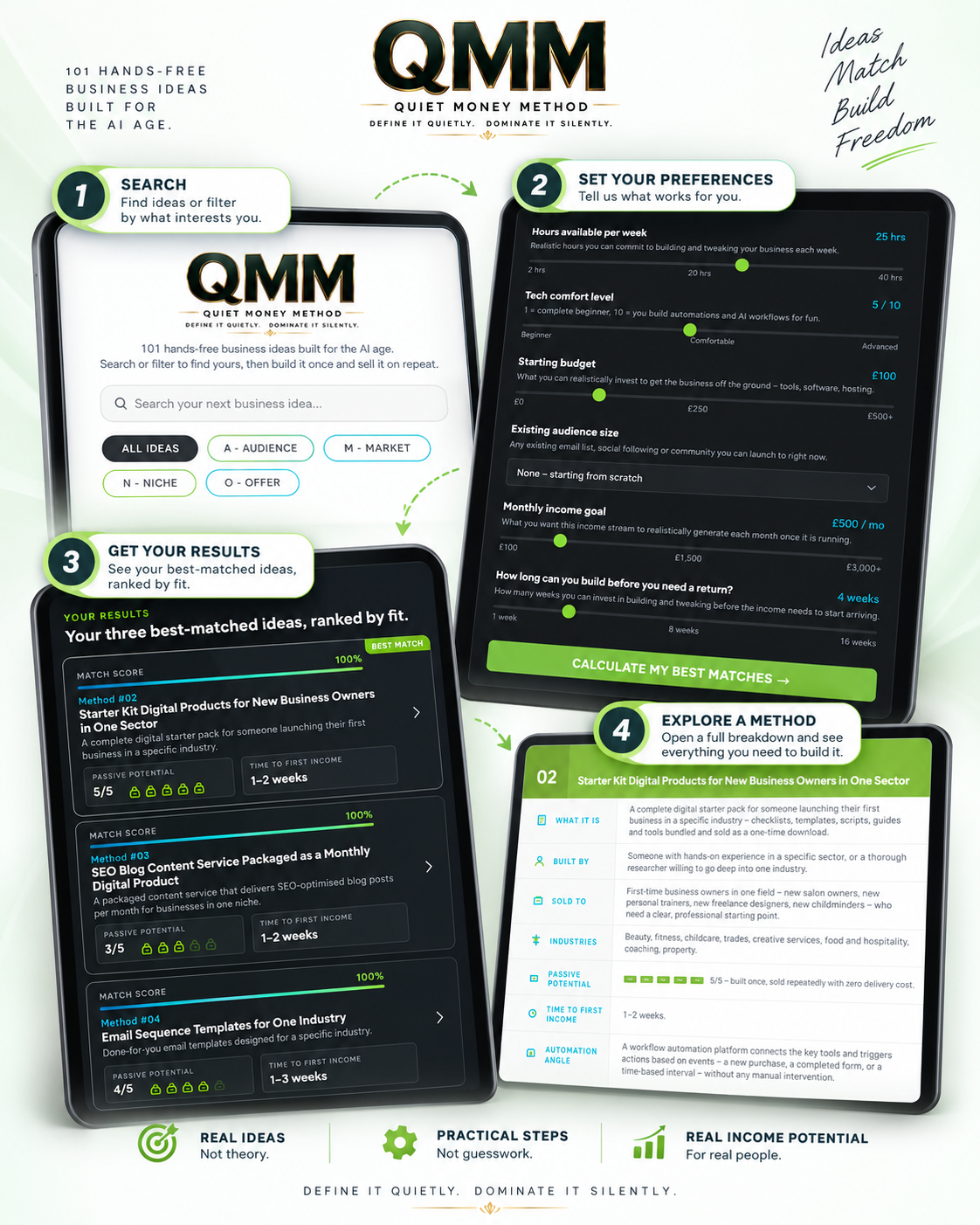
Quiet Money Method is a PassivAi® decision toolkit for choosing an income model before you build anything. According to its product page, it compares your hours, skills, tech confidence, budget and income goal against 101 profiled online income models.
- Compare models against your own constraints. A six-question NICHE-IT calculator shortlists the models that match your answers.
- See what each model asks of you. Each profile covers time to first income, tools, likely buyers and how much of the work can be automated.
- Keep your direction. You leave with a direction summary and a reusable AI skills file for the tools you use next.
Opens the Quiet Money Method page, where the full details are shown. Page checked 12 October 2026: one payment of £79. Results depend on your market, offer and decisions, so no income is promised.
Not sure whether your niche, offer, audience or market needs attention first? The free Online Business Compass asks six quick questions and points to the decision most likely to unblock progress.
A one-person business can stay small for as long as you want it to. The model you choose decides whether small means a full diary of client work, a weekly publishing habit or a catalogue that earns between updates. Pick the shape of week you want first, then find the model and the buyer that fit it.
Answers to the questions people ask before going it alone
What business can one person run alone?
Any of the twelve one person business ideas in this article can be run alone: freelance and fixed-price services, consultancy, templates, courses, information websites, paid newsletters, memberships, print-on-demand, affiliate content, micro-SaaS and licensing. The real limits are your hours and how much customer contact the model needs, rather than the legal structure.
What is the easiest one-person business to start?
For someone with a skill buyers already pay for, a freelance or fixed-price service is usually the simplest start. It needs little money up front and buyers already exist. Easiest to start is not the same as easiest to keep small, because a service grows by taking more of your time.
Can I run an online business without employees?
Yes. Government estimates put the number of UK private sector businesses with no employees other than the owners at 4.3 million at the start of 2025, around 75% of the total. That figure covers all kinds of business, online and offline. Many owners use freelancers and software for specific jobs rather than hiring staff.
Which one-person businesses have low start-up costs?
Freelance services, productised services, templates, affiliate content, newsletters and information websites can often start with a computer and modest software subscriptions. Print-on-demand avoids buying stock. Micro-SaaS usually costs more unless you can build it yourself. Our guide to start-up costs for business helps you work out your own figures.
Can a one-person business make money while the owner is offline?
Some models can take orders while you are away, including templates, recorded courses, licensed assets, affiliate content and information websites. They still need building, marketing and upkeep before and after that point, and no model guarantees sales.
What is the difference between a solopreneur and a sole trader?
Solopreneur is an informal word for someone who runs a business on their own. Sole trader is a legal and tax status: a self-employed person running an unincorporated business. A solopreneur might be a sole trader, or the only director and shareholder of their own limited company.
Do I need to register as self-employed in the UK?
If you trade and your trading income goes over £1,000 in a tax year, you will usually need to set up as a sole trader and register for Self Assessment with HMRC. Below that, the trading allowance may mean you do not need to tell HMRC. Check the current rules on GOV.UK, as this is general information rather than tax advice.
How can I tell whether anyone will buy my idea?
Look for evidence that people already spend money on the problem, talk to people who match your buyer and then offer a small, real version they can pay for. Interest is encouraging. A completed payment is evidence. The free Will Anyone Buy This? tool walks you through choosing a small, honest test.
Sources and further reading
- Department for Business and Trade, Business population estimates for the UK and regions 2025: statistical release, published 2 October 2025: 5.7 million private sector businesses at the start of 2025, of which 4.3 million (75%) had no employees aside from the owners. Official statistics in development.
- GOV.UK, Working for yourself: when selling goods or services counts as running a business, and running a business alongside employment.
- HMRC, Tax help for hustles: I work for myself: the £1,000 trading threshold and setting up as a sole trader.
- Business.gov.uk, choosing a business model: service, product and subscription models.
- GOV.UK, Setting up a business: legal structures, registration and first steps.
Last checked: 12 October 2026. Statistics refer to the start of 2025. Model groupings and table assessments are PassivAi® editorial judgements, not measured data, and examples are illustrative. Guidance, prices and thresholds change, so check each linked source before relying on it. Nothing here is financial, tax or legal advice.

Kerry Greener
Founder of PassivAi®. Working with commercial websites since 1995, and thirty years of building businesses, websites and online marketing campaigns for hundreds of different companies.
More about PassivAi®.
Test an idea
Find out whether anyone will pay before you make the full thing
Separate encouragement from evidence and choose a small, honest test before making the full thing.
Choose a model
Choose a model that fits your hours before you build anything
Compare your skills, budget and time against 101 profiled income models and leave with one direction.
Show me how it matches my model Make time
Find two hours a week to start something of your own
Recover two realistic hours from a normal week and turn them into a small routine you can protect.
FIND TWO HOURS YOU CAN REALLY USE